
Bathroom Vanity Materials to Avoid: The 2026 Guide to Durable Design
Have you ever wondered why that stunning “solid wood core” vanity you saw online is priced so much lower than the professional-grade options in a local showroom? It’s a heartbreaking reality for many homeowners when their beautiful new centerpiece begins to warp or peel just a few years after installation. When you’re curating your dream sanctuary, identifying the specific bathroom vanity materials to avoid is the single most important step in protecting your investment. We understand that you want a bathroom that provides both aesthetic validation and the practical security of long-term performance; you deserve a space that reflects your style without the fear of delamination.
We agree that deciphering marketing jargon and 2026 design trends can feel overwhelming, especially when you’re trying to distinguish between genuine quality and “disposable” furniture. This guide will give you the clarity you need to spot high-risk materials like standard MDF or particleboard that simply cannot handle the high-humidity environment of a modern home. You’ll learn how to evaluate vanity construction like a seasoned expert, ensuring your 60-inch double sink vanity or sleek wall-mount unit remains a durable, gorgeous centerpiece for a lifetime. We’re going to break down the “no-go” list and provide a framework for selecting resilient materials that will impress every guest who walks through your door.
Key Takeaways
- Understand the science of delamination and how steam and heat physically separate glues and veneers in common “big-box” furniture.
- Identify the specific bathroom vanity materials to avoid, including unsealed particle board and thin paper veneers that act as sponges in high-humidity environments.
- Learn the critical distinction between standard MDF and High Moisture Resistant (HMR) cores to ensure your painted finish stays flawless for years.
- Discover why furniture-grade plywood and solid hardwoods like oak, birch, and maple are the industry standards for structural integrity and lasting luxury.
- Gain a professional framework for evaluating vanity quality so you can invest in a centerpiece that provides both aesthetic validation and long-term performance.
The Silent Enemy: Why Common Bathroom Vanity Materials Fail
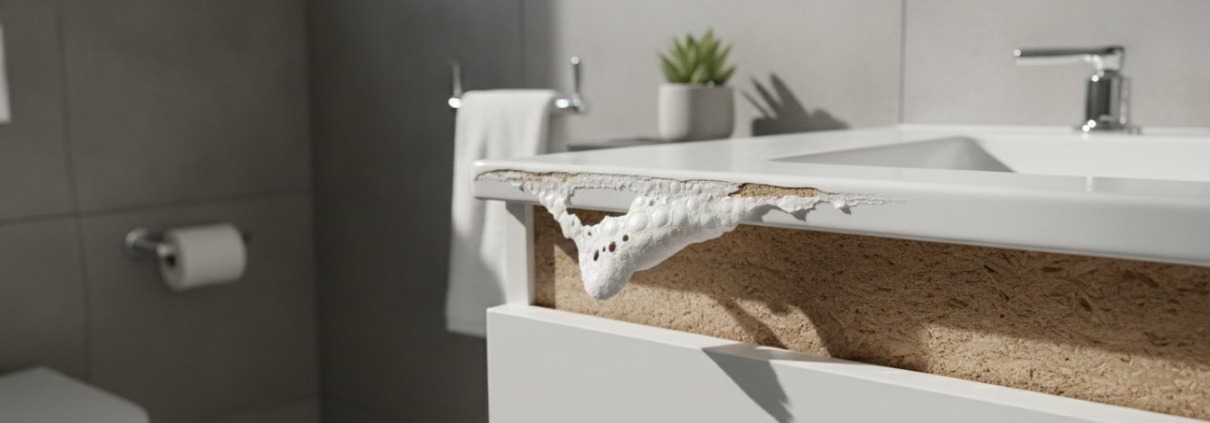
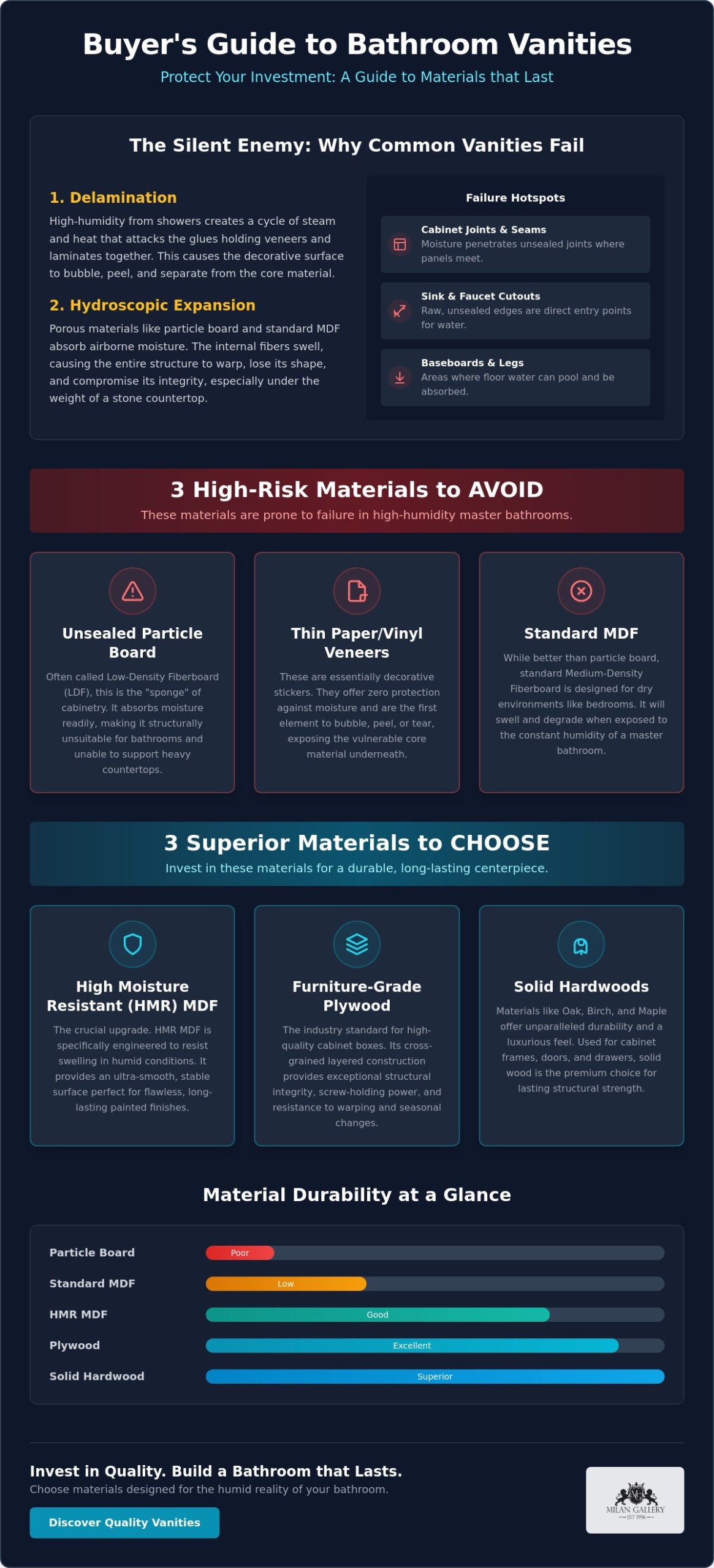
Why does that stunning showroom piece look like it is melting after only two years in your home? If you choose a material designed for a dry bedroom, you’re essentially setting a countdown on your investment. Identifying the bathroom vanity materials to avoid is not just about style; it is about understanding the physics of your home. Your bathroom is a localized weather system where steam and heat act as persistent stressors. When these elements penetrate the surface, they trigger delamination, a process where the industrial-grade glues holding veneers or laminates together begin to dissolve. This causes the decorative outer layer to bubble and peel away, leaving the vulnerable core exposed to even more damage.
The primary scientific culprit here is hydroscopic expansion. Hydroscopic expansion is the physical process where wood fibers or composite particles absorb ambient moisture from the air, causing the material to swell and lose its original structural dimensions. This swelling is most aggressive at specific failure points that are often overlooked during a quick shopping trip. You will typically see the first signs of trouble at the joints where cabinet panels meet, along the baseboards where water might pool on the floor, and around the sink cutouts where raw edges are often left unsealed. If you are browsing options like standard Medium-Density Fiberboard (MDF), you must ensure the piece is specifically rated for high-moisture environments or you will likely face these structural failures.
Master Bath vs. Powder Room: Does Location Change the Risk?
Does every bathroom in your home require the same level of material resilience? The short answer is no, but the stakes are much higher in your primary suite. High-traffic master baths endure multiple showers daily, creating a persistent “micro-climate” of high humidity that never truly dissipates. In these spaces, compromising on quality is a recipe for disaster. However, you might find a “guest bath exception” for a powder room that only sees occasional hand washing and lacks a shower. In these dry environments, you can sometimes prioritize aesthetics over extreme durability. Just remember that even the most expensive materials will eventually fail if your space lacks an ENERGY STAR certified fan to pull that heavy air out of the room.
The Long-Term Cost of “Cheap” Vanity Materials
Choosing a budget-friendly material often leads to a frustrating replacement cycle where you end up paying twice for a single renovation. If your vanity begins to warp or the finish starts to peel, it doesn’t just look bad; it actively devalues your property. In a competitive market like Los Angeles, buyers have a keen eye for quality. A failing vanity suggests that other “behind-the-wall” elements might have been neglected too. Beyond the financial loss, there is a significant environmental impact to consider. Disposable furniture made from low-grade particle board often ends up in landfills within five years because it simply cannot be repaired once the core has swollen. Investing in a durable, high-end piece is the more sustainable and fiscally responsible choice for your home.
3 Common Bathroom Vanity Materials to Avoid (And Why)
Are you feeling tempted by that incredibly low price tag on a mass-produced vanity? While it might look sleek in a catalog, certain bathroom vanity materials to avoid are essentially ticking time bombs for your remodel. When you’re investing in a 60-inch double sink vanity, you’re not just buying a box; you’re buying the foundation for your daily routine. Starting your project with the wrong material is like building a house on sand. Let’s look at the three most common culprits that fail when the steam starts to rise.
First on the list is unsealed particle board, often referred to as Low-Density Fiberboard (LDF). This material is the “sponge” of the cabinetry world because it consists of wood chips and sawdust glued together with high pressure. Because it lacks the density of superior alternatives, particle board is structurally unsuitable for supporting heavy stone tops like quartz or marble, as the constant weight can eventually cause the fasteners to pull right through the soft core. If water manages to seep into the unfinished edges, the entire unit will swell beyond repair. This is backed by research on wood composites in high humidity, which proves that lower-density materials suffer significantly more dimensional change than their high-performance counterparts.
Next, you should be wary of thin paper veneers. These aren’t the high-quality wood veneers you’ll find at a luxury bathroom showroom; instead, they’re essentially a photograph of wood grain printed on paper and glued to a cheap core. You’ll notice these failing first at the corners and edges, where the paper begins to curl and peel away from the cabinet box. Finally, low-grade MDF should be approached with extreme caution. While high-quality MDF has its place, the “furniture-grade” versions found in big-box stores lack the resin density required to survive a bathroom’s micro-climate.
The Danger of Particle Board (LDF) in Wet Environments
The real nightmare begins when water finds a path through your vanity’s screw holes or plumbing cutouts. Once water ingress occurs, the LDF core expands and loses its structural integrity, often leading to a total collapse of the internal shelving or the base. Unlike solid wood, LDF cannot be sanded or repaired once it has absorbed moisture. You can identify this material during a showroom visit by its surprisingly light weight and a coarse, grainy texture that feels like compressed sawdust on any unfinished surface.
Avoid “Mystery Meat” Wood Composites
Have you ever seen a product description that simply says “engineered wood” without any further detail? These “mystery meat” composites are often held together by cheap adhesives that can release Volatile Organic Compounds (VOCs) into your home. This off-gassing is a hidden health cost that many homeowners overlook in favor of a lower price point. Beyond health concerns, these unnamed composites struggle to hold hinges over time. The repeated stress of opening and closing doors eventually strips the soft internal fibers, leaving you with sagging doors that no longer close properly.
The MDF Debate: Is Medium-Density Fiberboard Always a “No-Go”?
Is Medium-Density Fiberboard really the villain of the bathroom world? While we have already discussed why certain low-grade versions are definitely bathroom vanity materials to avoid, the truth is more nuanced than a simple “yes” or “no.” At Milan Gallery Bathroom Vanities, we believe in providing you with the full picture so you can make a decision with absolute confidence. The real secret lies in the distinction between standard MDF and High Moisture Resistant (HMR) MDF. Standard MDF is designed for dry-room furniture and will swell at the first sign of a steamy shower, but HMR is engineered with specialized resins that create a far more resilient core. This material is a staple in high-end design because it offers a level of precision that natural wood sometimes cannot match.
One of the biggest misconceptions we encounter is the idea that if a piece looks like wood, it must be solid wood. Many manufacturers use clever finishes to mimic grain, but the core remains a mystery. However, for certain high-end design styles, the core material is actually less important than the finish itself. A high-quality lacquer or professional-grade paint acts as a waterproof suit of armor for the vanity. If the seal is perfect, the core stays dry. This is why we occasionally recommend premium engineered materials for specific contemporary aesthetics where a seamless, flawless surface is the ultimate goal. It is about choosing the right tool for your specific creative vision.
When MDF is Actually the Better Choice
Why would a luxury designer ever choose an engineered product over solid oak? The answer is stability. Solid wood is a living material that breathes, meaning it can expand and contract as Los Angeles temperatures and humidity levels fluctuate. This natural movement can sometimes cause hairline cracks in painted finishes over time. If you are dreaming of that ultra-sleek “Los Angeles Modern” high-gloss look, HMR MDF provides a perfectly stable, glass-smooth surface that will not shift. When combined with multi-layer waterproof coatings, these pieces offer incredible longevity and a level of aesthetic discernment that is hard to achieve with natural timber.
How to Spot Poorly Constructed MDF Vanities
How can you tell if you are looking at a reliable investment or a future headache? First, check the underside or the back of the unit. If you see exposed, unpainted edges where the raw brown material is visible, walk away; that is an invitation for moisture to destroy the core. You should also pay attention to the weight. High-quality HMR is dense and heavy, while cheap versions feel surprisingly light. Finally, try the “tap test.” Give the side panel a firm rap with your knuckles. A quality piece will sound solid and dull, while a low-density core will sound hollow and thin, signaling it is one of the bathroom vanity materials to avoid if you want your renovation to last.
Superior Alternatives: What to Look for Instead
Now that we have identified the bathroom vanity materials to avoid, let’s pivot to the high-performance selections that will transform your bathroom into a resilient masterpiece. You want a piece that doesn’t just look expensive on day one, but maintains its structural integrity through decades of steamy mornings and busy family routines. Investing in quality means looking beyond the surface finish to find materials that were born to thrive in high-moisture environments. Furniture-grade plywood offers superior screw-holding power because its alternating grain layers grip hardware threads far more effectively than the loose, brittle fibers of particle board. This structural difference is exactly why high-end designers prioritize these premium builds for their most ambitious projects.
When it comes to the vanity top, the 2026 market shows a clear preference for engineered quartz. Quartz is the most popular and practical choice for bathroom vanity countertops because its non-porous nature requires no sealing and naturally resists bacteria. While natural stone like marble offers a classic aesthetic, it is porous and prone to staining if not meticulously maintained. If you desire the look of natural stone with the durability of a modern innovation, high-grade quartz provides the perfect bridge between contemporary aesthetics and classic quality.
Why Plywood is the King of the Bathroom
Why do we consider plywood the gold standard for cabinetry? It’s all about the cross-grain construction. By layering thin sheets of wood in alternating directions, manufacturers create a panel that is incredibly resistant to warping and expansion. This strength-to-weight ratio is particularly critical when you are installing larger units like 72 inch double sink vanities, which must support the immense weight of stone countertops and integrated sinks. You can find more details on how dimensions impact material choice in our guide on bathroom vanity sizes, which helps you plan for the weight considerations of a major remodel.
The Beauty and Resilience of Solid Wood
There is something undeniably soulful about the presence of solid hardwoods like Oak, Birch, or Maple in a home. These species offer natural water resistance and a structural integrity that engineered products struggle to replicate. Perhaps the greatest benefit of solid wood is the “repairability” factor. If a solid wood vanity suffers a scratch or a minor ding after years of use, it can be sanded and refinished to look brand new. This makes it a “forever” foundation for your remodel, ensuring your investment remains a source of pride rather than a candidate for the landfill. By choosing these time-tested materials, you are securing the aesthetic validation of a space that will impress every visitor for a lifetime; for those who appreciate this level of craftsmanship in all areas of the home, the bespoke projects from Finest Furniture Studio offer excellent inspiration for high-end custom cabinetry.
Ready to see these premium materials in person? Explore our curated collection of high-end vanities and find the perfect durable centerpiece for your Los Angeles home.
Investing in Longevity: The Milan Gallery Bathroom Vanities Quality Standard
How do you ensure your dream remodel doesn’t turn into a maintenance nightmare? In a city as vibrant and discerning as Los Angeles, your home is more than just a shelter; it’s a social space that deserves the absolute best in both form and function. At Milan Gallery Bathroom Vanities, we don’t just curate beautiful fixtures; we act as your dedicated partner in identifying the bathroom vanity materials to avoid. We’ve spent over 15 years vetting every piece in our inventory to ensure it can withstand the unique Southern California humidity that often wreaks havoc on lesser-quality furniture. By focusing on high-performance finishes and moisture-resistant cores, we provide the practical security of a reliable investment alongside the excitement of top-tier design.
Our collaborative process is designed to match your specific lifestyle to the right material. Whether you’re designing a high-traffic family bathroom or a sleek guest suite, we’ll help you find the perfect balance between aesthetic validation and long-term performance. We understand that a vanity is a functional fixture, not just a piece of furniture; our standards reflect that philosophy in every drawer slide and cabinet hinge we offer. It’s about creating a space that feels both authoritative and neighborly, giving you the confidence to show off your home to friends and family alike.
Curated Designs for the Los Angeles Aesthetic
Are you looking for that perfect blend of contemporary style and classic quality? Our collection is meticulously selected to reflect the latest modern trends while prioritizing time-tested construction methods. For example, our 48 inch bathroom vanities are built using superior core materials that far exceed the industry standard for durability. If you’re seeking style inspiration for a mid-sized remodel, that guide offers a deep dive into how we marry trend-forward colors with the structural integrity required for a lasting renovation. We don’t believe you should ever have to choose between a gorgeous “Los Angeles Modern” look and a piece that will actually last a lifetime.
Visit Our Showroom for a “Touch and Feel” Consultation
It’s easy to be fooled by a polished photo on a website, but the true quality of a material is something you can only appreciate in person. We invite you to visit our Sun Valley showroom to experience the Milan Gallery Bathroom Vanities difference for yourself. You can run your hands over our non-porous quartz tops, test the weight of our solid wood frames, and hear the solid thud of a well-constructed cabinet door. Our expert team will guide you through our collection of single and double sink vanities, sharing insights from our 15 plus years of Los Angeles remodeling experience. Don’t leave your investment to chance; visit us in Sun Valley today to start your creative journey and find a piece that will impress your social circle for years to come.
Start Your Durable Design Journey Today
Ready to transform your bathroom into a resilient masterpiece that truly stands the test of time? We have uncovered the science behind delamination and identified the specific bathroom vanity materials to avoid so you can choose a centerpiece that remains as stunning as the day it was installed. You now have the professional framework to distinguish between “disposable” furniture and the high-performance plywood or solid hardwoods that define a quality investment. At Milan Gallery Bathroom Vanities, we bring over 15 years of Los Angeles expertise to every consultation, ensuring your home benefits from exclusive designs that thrive in our unique climate.
We invite you to visit one of the largest showrooms in the Sun Valley area to feel the difference of our hand-vetted, high-performance materials for yourself. Whether you are looking for a sleek wall-mount unit or a grand double vanity, our team is here to guide you toward a selection that balances aspirational luxury with grounded practicality. Let’s work together to turn your renovation into an inspiring creative journey that yields a lifetime of rewards.
Explore Our Collection of High-Quality Vanities at Milan Gallery Bathroom Vanities
We’re excited to help you create a space that provides both aesthetic validation and the lasting security your family deserves. Your dream bathroom is closer than you think!
Frequently Asked Questions
Is solid wood better than plywood for a bathroom vanity?
Neither material is strictly better, but they serve different structural purposes in a high-quality build. Plywood is often preferred for cabinet boxes because its cross-grain construction provides incredible dimensional stability in high humidity. Solid wood is a fantastic choice for frames and doors because it offers a timeless aesthetic and superior repairability. We recommend a combination of both to ensure your investment remains a durable, gorgeous centerpiece for years to come.
Can I use a regular dresser as a bathroom vanity if I seal it?
You can certainly try, but it’s a risky move that often leads to structural failure within a few years. Most dressers are designed for dry bedrooms and use adhesives that simply aren’t rated for a steamy micro-climate. Once you cut into the frame for plumbing, you expose raw edges to moisture. For this reason, repurposed bedroom furniture often falls into the category of bathroom vanity materials to avoid for long-term reliability.
How can I tell if a vanity is made of particle board before buying?
The easiest way to identify particle board is by checking the weight and examining any unfinished surfaces, such as the back or underside of the unit. Particle board is surprisingly light and has a coarse, grainy texture that looks like compressed sawdust. If you see raw, brown edges that haven’t been painted or sealed, it’s a sign the manufacturer used bathroom vanity materials to avoid that will likely swell when exposed to water.
What is the best material for a vanity top to avoid staining?
Engineered quartz is the gold standard for stain resistance in 2026 because it’s a non-porous material that requires no annual sealing. Unlike natural stones like marble or granite, quartz doesn’t have microscopic pores that trap oils, makeup, or toothpaste. This makes it incredibly easy to maintain while providing the practical security of a surface that resists bacteria and stays flawless even in a high-traffic family bathroom.
Does Los Angeles humidity affect which vanity materials I should choose?
Los Angeles homes experience unique environmental stressors, from coastal salt air to significant indoor humidity fluctuations in older neighborhoods. These conditions make moisture-resistant cores essential because inferior wood composites will react to our local climate by warping or expanding. We vet our entire inventory specifically for the Southern California lifestyle, ensuring that every piece we sell can handle these localized weather patterns while maintaining its structural integrity and high-end aesthetic.
What are the signs that my current vanity is failing due to material issues?
You’ll typically notice bubbling along the baseboards or peeling at the corners of the cabinet doors where the veneer is starting to lift. These are clear indicators of delamination caused by steam penetrating a weak finish. If your drawers have become difficult to open or close, it’s often a sign that the internal core has absorbed moisture and expanded, causing the hardware to shift out of its original alignment.
Is quartz more durable than marble for a bathroom vanity top?
Quartz is significantly more durable than marble because it’s much harder and naturally resistant to the etching caused by acidic soaps or cleaners. While marble offers a classic luxury look, it’s a soft, porous stone that can chip or stain quite easily if it isn’t meticulously maintained. Quartz provides that same aspirational beauty with far more resilience, making it the superior choice for homeowners who want a low-maintenance, high-performance surface.
How long should a high-quality bathroom vanity last?
A high-quality vanity built from furniture-grade plywood or solid hardwood should easily last 15 to 20 years or more with proper ventilation. The longevity of your piece depends on the quality of the internal materials and the thickness of the waterproof coatings applied at the factory. By choosing a well-constructed unit from the start, you’re investing in a “forever” foundation that provides lasting aesthetic validation and avoids the cycle of disposable furniture.