
Water Resistant Bathroom Vanity Materials: The 2026 Guide to Longevity
What if your stunning new bathroom centerpiece started to swell and peel just months after the final tile was laid? It’s a heartbreaking reality for many homeowners who accidentally overlook the technical science behind water resistant bathroom vanity materials during their design process. We know you want a space that feels like a high-end sanctuary, but you also need the practical security of knowing your investment won’t rot under the pressure of daily steam and splashes. It’s completely natural to feel torn between the classic appeal of solid wood and the modern resilience of engineered options, especially when you’re planning for a busy family environment.
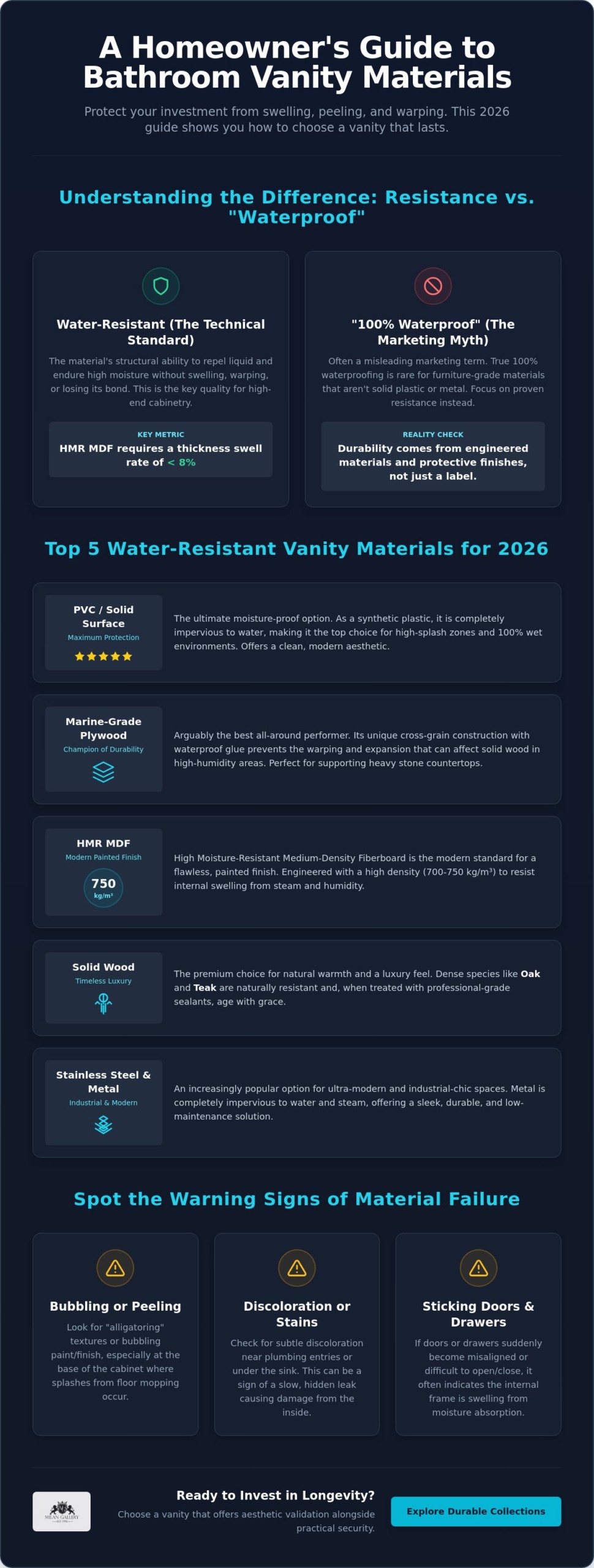
This 2026 guide is here to be your dedicated partner, promising to clear away the confusion and show you how to choose a vanity that stays gorgeous for decades. We will walk you through the latest industry standards, from HMR MDF with thickness swell rates below 8 percent to the incredible 5-star waterproof rating of modern PVC. You’ll discover how to achieve that perfect bridge between contemporary aesthetics and time-tested quality so your home remains a source of pride, social validation, and lasting resale value.
Key Takeaways
- Learn why “100% waterproof” is often a marketing myth and how to identify true moisture-defying performance in your cabinetry.
- Discover why the cross-grain construction of marine-grade plywood often outperforms solid planks when it comes to preventing structural warping.
- Identify which water resistant bathroom vanity materials actually support heavy stone countertops while surviving the daily steam of a busy family home.
- Understand the vital role of high-pressure laminates and professional sealants as the final defensive shield for your vanity’s core.
- Gain the confidence to choose a vanity that offers the aesthetic validation you desire alongside the practical security of a long-term investment.
Understanding Water Resistance vs. Waterproofing in Vanities
Have you ever wondered why some vanities look pristine for decades while others start to crumble after just one humid summer? It’s often because the term “waterproof” is used as a marketing buzzword rather than a technical reality. In the world of high-end cabinetry, we prefer to talk about water resistant bathroom vanity materials because true 100 percent waterproofing is almost impossible for furniture-grade items that aren’t made of solid plastic or stainless steel. When you invest in a beautiful new center-piece for your home, you deserve to know exactly how it will stand up to the test of time.
Water resistance is the structural ability of a material to repel liquid and endure high levels of moisture without swelling, warping, or losing its bond. If you want a technical definition to guide your shopping, it’s this: Water-resistant materials are those engineered with exceptionally low absorption rates and protected by high-bond finishes that act as a microscopic shield. You are essentially fighting a battle against three primary enemies: standing water that pools on surfaces, high humidity that lingers in the air, and the penetrating steam from your daily shower. While modern standards like the 2026 HMR MDF requirements mandate a thickness swell rate of less than 8 percent, even the best water resistant bathroom vanity materials need a partner in protection to remain structurally sound.
The Role of Humidity in Southern California Bathrooms
Living in Los Angeles means your home faces unique environmental challenges that many national retailers simply don’t consider. If you’re in the dry heat of the San Fernando Valley, your vanity might experience different stresses than a home nestled in the coastal moisture of Santa Monica. These rapid temperature shifts cause materials to expand and contract at different rates. Without proper ventilation as your first line of defense, the salt-heavy air or the intense valley heat can accelerate wear. We always recommend choosing materials that can handle these local micro-climates without losing their aesthetic charm.
Common Signs of Material Failure to Watch For
It’s vital to catch damage early before it compromises the entire unit and leads to an expensive replacement. Keep a close eye out for these red flags during your weekly cleaning:
- Bubbling or “alligatoring” textures at the base of the cabinet or along the seams where floor mopping or splashes occur.
- Subtle discoloration near plumbing entries or directly under the sink where slow, hidden leaks often do the most damage.
- Drawer misalignment or doors that suddenly stick; this usually indicates the internal frame is swelling from moisture absorption.
By staying vigilant, you can protect the luxury look of your bathroom and ensure your vanity maintains its resale value for years to come.
Top 5 Water-Resistant Bathroom Vanity Materials for 2026
Selecting the right foundation for your remodel is more than just an aesthetic choice; it’s a commitment to your home’s future. When you’re browsing for water resistant bathroom vanity materials, you’ll find that the industry has made incredible leaps in engineering lately. We want you to feel absolutely confident that the piece you fall in love with today will still be a source of pride a decade from now. It’s about finding that sweet spot where aspirational design meets grounded, local practicality.
- Solid Wood: This remains the premium choice for those who desire natural warmth. Species like Oak and Teak are naturally dense and, when treated with professional-grade sealants, offer a luxury feel that ages with grace.
- Marine-Grade Plywood: This is arguably the champion of durability. Its unique cross-grain construction prevents the warping and expansion that often plagues solid planks in high-humidity environments.
- HMR MDF (High Moisture Resistant): For homeowners who dream of a flawless, painted finish, this is the modern standard. It’s specifically engineered with a density between 700 and 750 kg/m³ to resist internal swelling.
- Solid Surface or PVC: These materials are the ultimate moisture-proof options. PVC earns a 5-star rating for 100 percent wet environments, making it perfect for high-splash zones.
- Stainless Steel and Metal: These industrial-chic options are becoming increasingly popular for ultra-modern LA lofts, offering a sleek look that is completely impervious to steam.
Plywood vs. MDF: The Great Debate Settled
We often get asked which is better, and the answer usually depends on your specific goals. Plywood offers incredible screw-holding power, which is vital for heavy-use drawers and doors. On the other hand, HMR MDF provides a smoother surface for high-gloss or matte paint finishes that won’t show wood grain. Often, your choice of bathroom vanity sizes will influence this decision. Larger units require the specific structural rigidity that only high-grade plywood or reinforced HMR can provide to stay perfectly level over time.
Structural Integrity for Large Double Vanities
If you’re eyeing a 72 inch double sink vanity, the frame must be exceptionally robust. A heavy quartz or marble countertop can weigh hundreds of pounds, and lower-quality particle board will eventually sag under this pressure. This sagging leads to cracked seams and water intrusion, which is why we prioritize reinforced corners and solid backs. You can explore our curated selection of high-performance vanities to see how these structural details come together to create a lasting masterpiece for your home.
The Shield: How Finishes and Sealants Complete the Protection
Have you ever wondered why a beautiful vanity looks impeccable in the showroom but loses its luster after just one year of steamy showers? The truth is that the water resistant bathroom vanity materials we explored earlier are only as strong as the barrier protecting them. You can have the highest-grade marine plywood, but if the finish is thin or poorly applied, moisture will eventually find its way in. We view the finish as the ultimate defensive shield, acting as a bridge between contemporary aesthetics and classic quality that ensures your investment remains a source of pride for your social circle.
One of the most robust “skins” available today is High-Pressure Laminate (HPL). This isn’t the countertop material of the past; modern HPL is an incredibly dense, multi-layered resin that is fused to the core material under intense heat and pressure. It creates a surface that is nearly impossible to scratch and completely impermeable to water. For those who prefer a painted look, a multi-layer lacquer process is the gold standard. When a vanity receives five or more coats of high-quality polyurethane lacquer, it creates a deep, rich finish that seals every pore of the wood. This level of craftsmanship provides the practical security you need in a high-traffic family bathroom.
You might be surprised to learn that a high-quality veneer on a plywood core is often more stable than solid wood in a bathroom environment. Solid wood is a living material that breathes, expands, and contracts with the humidity of a Los Angeles summer. A premium veneer provides the aesthetic validation of real wood grain while the plywood core prevents the structural warping that can lead to cracked finishes and water intrusion.
The Importance of Edge Banding
If you want to spot a low-quality vanity before you buy it, look at the seams. The edges of the cabinet doors and panels are the number one point of water entry. We always look for PUR (Polyurethane) edge banding. Unlike standard glues that can melt or peel when exposed to heat and steam, PUR creates a chemical bond that is virtually moisture-proof. It ensures that the edges of your water resistant bathroom vanity materials stay crisp and sealed even after years of daily use.
Natural Stone and Quartz Top Compatibility
The transition where your countertop meets the cabinet is a critical moisture junction that requires careful attention. We highly recommend non-porous surfaces like quartz because they don’t absorb water that could eventually “wick” down into the cabinet core. During installation, using high-grade silicone sealants at this junction is vital. This simple step prevents standing water from seeping behind the vanity, protecting the furniture beneath and maintaining the long-term performance of your entire bathroom suite.
Choosing the Right Material for Your Specific Bathroom Type
Are you designing a tranquil, spa-like retreat for yourself or a high-energy splash zone for the kids? The best water resistant bathroom vanity materials for one room might be a total mismatch for another, and understanding this distinction is the key to a successful remodel. It’s about matching the specific material properties to the “Splash Factor” and usage frequency of your household. If you’re updating a rarely-used guest powder room in the Hollywood Hills, you have more freedom to prioritize aesthetic discernment over extreme moisture resistance. However, if you’re tackling a high-traffic family space, the practical security of a reliable investment becomes your top priority. To truly feel the difference between these textures, we always recommend visiting local bathroom supply stores where you can see how these high-performance materials catch the light and feel under your touch.
Master Suite: The Luxury Performance Balance
In a master suite, you’re looking for a bridge between contemporary aesthetics and classic quality. This is where solid wood or marine-grade plywood truly shines as the gold standard. Since master bathrooms typically see more steam but less direct “puddle” splashing than a kids’ room, you can safely invest in premium 60-inch to 84-inch double sink formats that offer incredible social validation. We often suggest matching the vanity material and finish to your freestanding bathtub to create a cohesive, curated design that feels like a personal sanctuary. The goal here is a luxury look that maintains its resale value while supporting the heavy quartz or marble tops you’ve dreamed of.
Kids and High-Traffic Bathrooms: Prioritizing Durability
For the younger members of the family, the “Splash Factor” is at its peak. In these high-traffic areas, PVC or HPL-coated water resistant bathroom vanity materials are essentially the bulletproof choice. These surfaces are incredibly easy to clean and resist the soap scum, toothpaste, and standing water that are inevitable in a shared family space. We’ve found that wall-mount vanities are particularly effective in these rooms. They make floor cleaning a breeze and prevent moisture from being trapped at the base of the cabinet. By prioritizing these resilient materials, you transform a potentially overwhelming maintenance schedule into an inspiring, low-stress environment. If you’re ready to find the perfect balance of style and strength for your home, explore our high-performance vanity collections today.
Investing in Longevity at Milan Gallery Bathroom Vanities
How do you transform all this technical knowledge into a beautiful, lasting reality for your home? At Milan Gallery, we’ve spent the last 15 years acting as a dedicated partner for Los Angeles homeowners, refining our material standards to ensure every piece we offer meets the highest benchmarks for durability. We understand that selecting the right water resistant bathroom vanity materials can feel like a high-stakes decision, but our curated selection is designed to eliminate that uncertainty. When you step into our Sun Valley showroom, you aren’t just looking at furniture; you’re experiencing the tactile reassurance of premium finishes and reinforced construction that can survive the busiest households. We pride ourselves on being a local authority that prioritizes time-tested values of quality, ensuring your remodel is both an inspiring creative journey and a secure investment.
Why settle for a generic big-box solution when you can have a centerpiece that acts as a bridge between contemporary aesthetics and classic quality? Our team is deeply invested in your domestic success, and we’ve seen firsthand how the right material choice can elevate a room from a simple utility space to a high-end sanctuary. We don’t just sell functional fixtures. We provide the aesthetic validation that will impress your social circle while giving you the peace of mind that your vanity will stay beautiful for decades.
Exclusive Designs Built for the LA Lifestyle
If you’re looking for a specific size to fit your layout, our range of 48 inch bathroom vanities features moisture-resistant cores specifically chosen for the Southern California climate. Because we utilize a direct-to-consumer model, we can offer higher material specifications, like reinforced marine-grade plywood and high-density HMR MDF, at competitive prices that respect your budget. We even offer personalized consultations to help you navigate water resistant bathroom vanity materials based on your specific zip code, whether you’re facing the coastal humidity of the Westside or the dry heat of the Valley.
Take the Next Step in Your Remodel
Are you ready to see these high-performance materials in person? We invite you to visit our Los Angeles location to feel the quality of our multi-layer lacquers and examine the precision of our PUR edge banding for yourself. If you prefer the convenience of home shopping, our e-commerce platform is filled with modern and traditional styles that never compromise on structural integrity. Our expert guidance is always available to help you make a choice you’ll be proud of for years to come. Visit our showroom or browse our water-resistant vanity collection today!
Secure Your Bathroom’s Future with Confidence
You now have the technical knowledge to ensure your next remodel isn’t just a temporary facelift but a decades-long investment. By selecting the ideal water resistant bathroom vanity materials and pairing them with high-performance finishes, you create a space that withstands the daily pressures of steam and splashes. Remember that true longevity comes from matching the material to your specific household usage, whether it’s a high-traffic family zone or a luxury master retreat. This thoughtful approach ensures your home remains a source of pride and aesthetic validation for your social circle for years to come.
Milan Gallery brings over 15 years of Los Angeles expertise to your project, offering exclusive moisture-resistant designs at one of the largest showrooms in Southern California. We’re dedicated to helping you find that perfect bridge between contemporary aesthetics and classic quality. It’s time to transform your vision into a stunning reality that maintains its resale value and beauty. Explore Our Premium Water-Resistant Vanities today and start your journey toward a bathroom built to last. We’re excited to help you create something extraordinary.
Frequently Asked Questions
Is solid wood or plywood better for a bathroom vanity?
Marine-grade plywood is technically superior for structural stability because its cross-grain construction prevents the warping often seen in solid wood planks. While solid wood offers an aspirational luxury feel, it naturally expands and contracts with the Los Angeles humidity. Plywood provides the practical security of a reliable investment, especially when supporting heavy stone countertops in high-traffic master suites.
Can I make my current bathroom vanity waterproof?
You can significantly improve the resistance of an existing unit by applying several coats of high-quality polyurethane or a specialized wood sealant. However, it’s difficult to make a vanity truly waterproof if the core material wasn’t engineered for moisture from the start. Focusing on the seams and plumbing entries with silicone is a great way to add a defensive shield to your current setup.
How long should a high-quality water-resistant vanity last?
A vanity crafted from high-performance water resistant bathroom vanity materials should easily last 15 to 20 years with basic maintenance. The exact lifespan depends on the quality of the factory-applied finish and the ventilation in your specific bathroom. Investing in quality today ensures your space maintains its resale value and continues to impress your visitors for decades to come.
What is the most water-resistant material for a vanity top?
Quartz is widely considered the most water-resistant material for a vanity top because it’s completely non-porous and hygienic. Unlike natural marble or granite, quartz doesn’t require regular sealing to prevent moisture from wicking into the stone. This makes it an ideal partner for our moisture-defying cabinetry, providing a luxury look that’s incredibly easy to maintain.
Does MDF always swell in the bathroom?
No, only standard furniture-grade MDF is prone to rapid swelling; bathroom-grade HMR MDF is specifically engineered to resist moisture. As we discussed, the 2026 technical standards for HMR MDF require a thickness swell rate of less than 8 percent. This material is an excellent choice for a flawless, painted finish that won’t bubble or fail in a steamy environment.
Are wall-mounted vanities better for preventing water damage?
Wall-mounted vanities are excellent for preventing damage because they eliminate the risk of water wicking up from the bathroom floor. By elevating the cabinet, you prevent moisture from being trapped against the base during mopping or after a shower. This style also makes it much easier to keep your floors pristine, which is a big win for busy family bathrooms.
How do I clean a water-resistant vanity without damaging the finish?
You should use a soft microfiber cloth dampened with mild soap and warm water to protect the integrity of the finish. Avoid abrasive scrubbers or harsh chemical cleaners that can strip away the protective lacquer or sealant over time. Drying the surface immediately after cleaning is the best way to ensure your water resistant bathroom vanity materials remain vibrant and beautiful.
What should I do if my vanity starts to show signs of water damage?
You must first identify and stop the source of the moisture, whether it’s a hidden plumbing leak or poor ventilation. Once the area is dry, you can sometimes sand and reseal localized damage if the core hasn’t structurally failed. If you notice significant bubbling or frame misalignment, it might be time to visit our Sun Valley showroom to explore a more durable replacement.