Double Vanity Dimensions: The Ultimate 2026 Guide to Master Suite Planning
Is your dream of a symmetrical master suite being clouded by the nagging fear that your new cabinet might block the bathroom door or leave you bumping elbows every single morning? While most homeowners focus purely on the aesthetic finish, the real secret to a truly luxurious space lies in mastering the technical double vanity dimensions before you ever commit to a purchase. We understand that the transition from a cramped single sink to a double setup can feel overwhelming, especially when you’re caught between traditional heights and the modern “comfort” height preferences that 72% of industry professionals are now prioritizing for wellness and accessibility. You shouldn’t have to deal with the anxiety of plumbing that doesn’t line up or the frustration of a vanity that cramps your style.
In this guide, we’ll walk you through the essential 2024 IRC clearances and the NKBA’s 36 inch centerline recommendations to ensure your remodel increases your home’s value and provides the sanctuary you deserve. We will cover everything from the required 21 inches of floor space to the latest 2026 trends in wood-faced finishes, giving you the professional reassurance to transform your bathroom into a perfectly planned retreat. By the time you finish reading, you’ll have the precise measurements needed to choose between a 60 inch or a 72 inch model with absolute confidence.
Key Takeaways
- Identify whether a 60-inch space-saver or an 84-inch grand unit fits your lifestyle, ensuring you have ample “elbow room” for two people to get ready simultaneously.
- Master the “center-to-center” plumbing measurements to guarantee your sinks align perfectly with your rough-ins, eliminating the anxiety of costly mid-project corrections.
- Explore the ergonomic benefits of 36-inch “Comfort Height” cabinetry and how this modern standard transforms your daily routine into a more accessible, spa-like experience.
- Calculate precise double vanity dimensions for clearances to ensure your bathroom doors, shower glass, and walkways remain completely unobstructed and inviting.
- Gain the confidence to select the ideal wall-mount or freestanding style that will maximize your home’s aesthetic validation and long-term resale value.
Standard Double Vanity Widths: From Compact 60″ to Grand 84″
Have you ever wondered why some bathrooms feel like a cramped chore while others feel like a high-end retreat? The answer usually comes down to how you handle your double vanity dimensions during the initial planning phase. Width is the most impactful factor in your layout; it dictates how much breathing room you’ll have during the morning rush and how much storage you can tuck away behind beautiful doors. From the compact efficiency of a 60-inch model to the sprawling luxury of an 84-inch sanctuary, every inch counts in creating a space that feels both personal and professional.
The 60-Inch Standard: Pros and Cons
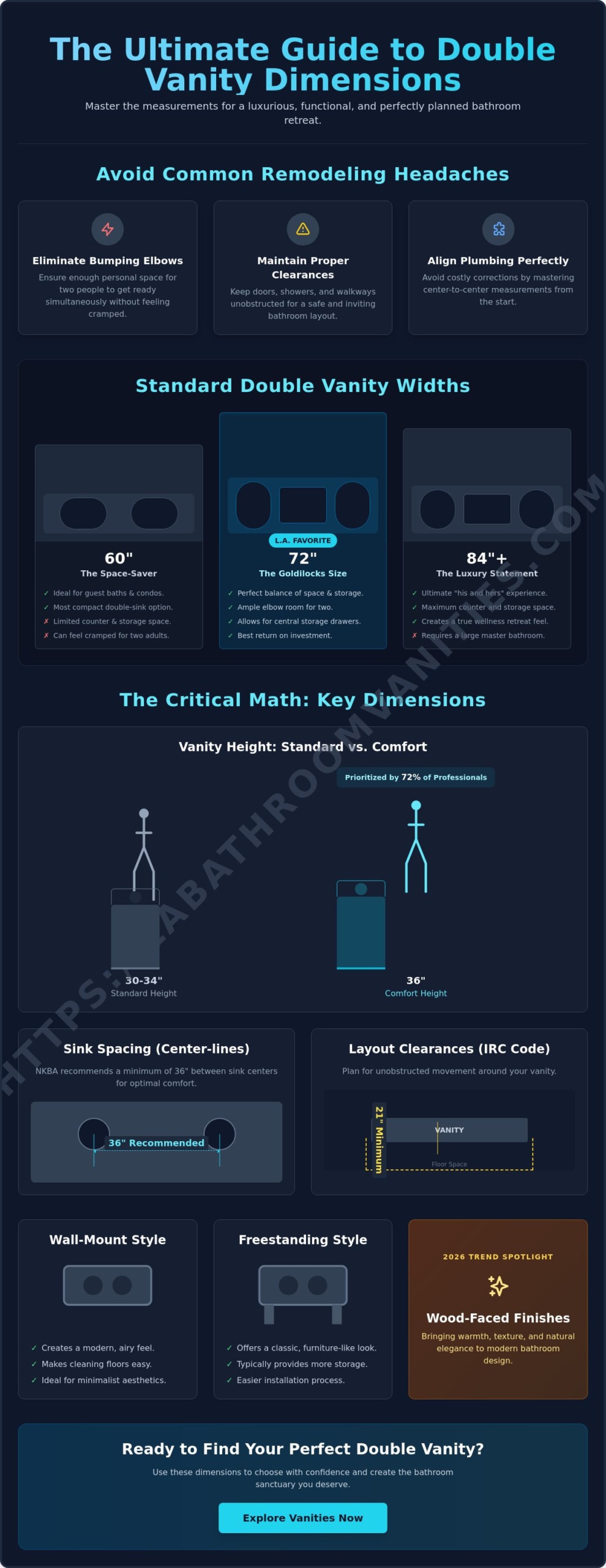
If you’re working with a tighter footprint in a North Hollywood bungalow or a Burbank condo, the 60-inch double vanity is your go-to solution. It’s the most compact way to provide two sinks, but it does require some strategic thinking. Because the cabinet is narrower, you often have to use smaller sink basins to preserve any “landing zone” for your toiletries. When you’re comparing different standard vanity dimensions, you’ll see that 60-inch models prioritize function over counter space. It’s a smart choice for guest baths or smaller master suites where every square foot is at a premium, but be prepared for a more intimate morning experience with your partner.
The 72-Inch Powerhouse: The Los Angeles Favorite
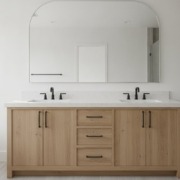
Why do so many Southern California homeowners gravitate toward the 6-foot mark? A 72 inch double sink vanity is widely considered the “Goldilocks” size because it offers the best return on investment for a master remodel. This width allows for a generous central bank of drawers between the two plumbing sections, giving you organized storage that 60-inch models simply can’t match. It anchors a large wall with a sense of permanence and prestige. If your bathroom can accommodate the extra foot, this size provides the ideal balance; you get plenty of elbow room without overwhelming the rest of your fixtures.
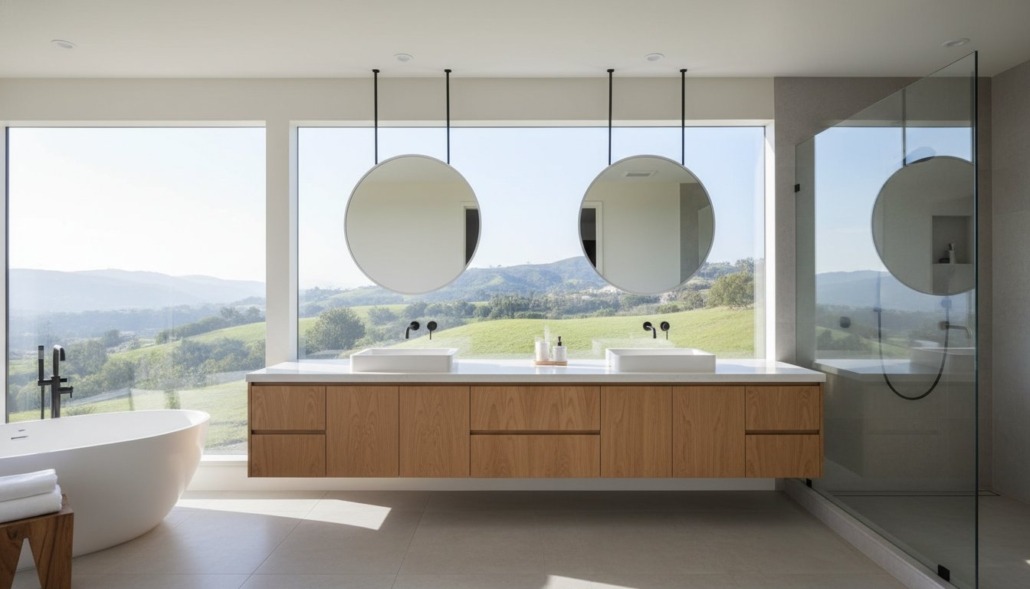
For those who want to create a true “his and hers” sanctuary, an 84-inch or larger vanity is the ultimate statement of luxury. These grand pieces offer enough space for two people to get ready without even a hint of overlap, often allowing for larger LED mirrors and more decorative lighting. While custom-built cabinetry is an option some consider, many Los Angeles homeowners find that pre-fabricated double vanity dimensions in these larger sizes offer a more reliable and cost-effective path to a high-end look. You get the aesthetic validation of a designer piece with the practical security of a unit built to withstand the humidity and daily wear of a busy bathroom. Choosing a freestanding or wall-mount unit in these expansive widths ensures your master suite feels like a dedicated wellness retreat rather than just a functional room.
The Critical Math: Sink Spacing and Center-Line Measurements
Have you ever considered how a few inches can make the difference between a peaceful morning and a frustrating game of “bumper-cars” with your partner? When we talk about double vanity dimensions, the most overlooked detail is often the technical math behind sink placement. If the sinks are positioned too close together, you lose that sense of personal sanctuary that a master suite is supposed to provide. By focusing on the “center-line” during your rough-in phase, you ensure that your plumbing and your personal space are in perfect alignment from day one. This isn’t just about code compliance; it’s about engineering a harmonious start to your day.
Calculating Sink Center-Lines
To get your plumbing right, you must understand exactly where the water will flow. The center-line measurement is the distance from the side edge of the vanity to the center of the sink drain. In a standard 60-inch vanity, the sinks are often squeezed with center-lines only 30 inches apart, which can feel tight for two adults. However, the National Kitchen & Bath Association (NKBA) recommends a distance of at least 36 inches between the center-lines of two sinks to achieve true comfort. When you move up to 72-inch or 84-inch configurations, you gain the flexibility to spread these points further apart, creating a much more relaxed environment.
- 60-inch vanities: Typically feature center-lines 30 inches apart.
- 72-inch vanities: Often allow for 36 to 40 inches of separation.
- 84-inch vanities: Provide maximum “his and hers” distance, often exceeding 42 inches between drains.
Eronomic “Elbow Room” Standards
A buffer zone of 12 to 15 inches between the inner edges of the two sink basins is the gold standard for adult routines. This specific gap allows both people to bend, wash, and groom without clashing elbows. Your range of motion is also heavily influenced by counter-depth. A standard 21-inch deep cabinet provides a solid foundation, but if you choose wide-spread faucets, they require more “visual” space to avoid looking cluttered. Under-mount sinks are fantastic for maximizing usable counter area, whereas vessel sinks sit on top and can make the vanity surface feel more crowded than the measurements suggest.
If you’re feeling unsure about the math, browsing our collection of modern double vanities can help you visualize how these different spacings look in real-world designs. We want you to feel confident that your chosen layout provides the aesthetic validation you want while maintaining the practical functionality you need. Remember that your choice of faucet also plays a role; a single-hole faucet takes up less physical and visual real estate, which can be a lifesaver if you’re working with the tighter end of the double vanity dimensions spectrum.
Standard Depth and Height: Finding the “Comfort” Zone
While width often steals the spotlight, the vertical and horizontal depth of your cabinetry are the silent heroes of a functional master bath. Getting your double vanity dimensions right means looking beyond the horizontal wall space and considering how the unit interacts with your body and the room’s traffic flow. In the diverse architectural landscape of Los Angeles, from the sprawling mid-century ranches of Sherman Oaks to the sleek, compact condos in Santa Monica, these measurements can make or break the feel of your renovation. You deserve a space that feels tailored to your lifestyle rather than a compromise with existing walls.
Depth and Traffic Flow
The industry benchmark for bathroom depth is 21 inches, and there’s a good reason for this specific number. It’s the perfect sweet spot that provides enough internal volume for modern plumbing and storage drawers while still leaving room for the 21 inches of clear floor space required by the 2024 International Residential Code (IRC). If you’re remodeling an older home with a narrower footprint, you might feel tempted to squeeze in a standard unit, but don’t forget to account for “drawer extension.” It’s incredibly frustrating to have a beautiful vanity where the drawers hit the opposite wall or a toilet before they’re fully open. For guest suites or the increasingly popular ADUs popping up across the Valley, a narrow-depth 18-inch solution can be a lifesaver, though it usually requires specialized sinks to fit the slimmer profile.
The Rise of Comfort Height
Are you still bending over a sink that feels like it was designed for a child? The traditional standard of 30 to 32 inches is rapidly fading into the past. As of 2026, “comfort height” vanities, which stand between 34 and 36 inches, have become the preferred choice for adult primary bathrooms. This shift aligns your bathroom counters with your kitchen counters, significantly reducing the strain on your back during your morning and evening routines. It’s a small change that offers massive ergonomic benefits, making your home feel modern and thoughtfully designed for long-term residency.
However, if you’ve fallen in love with the aesthetic of vessel sinks, you need to adjust your planning. Since these basins sit on top of the counter, installing them on a 36-inch cabinet can lead to an uncomfortable “high-shoulder” reaching position. In these cases, or if you’re simply aiming for an ultra-modern look, wall mount vanities offer the ultimate flexibility. Because they float above the floor, you can mount them at the exact height that suits your stature, creating a truly bespoke experience. Whether you choose a freestanding model or a floating design, prioritizing these vertical double vanity dimensions ensures your master suite is as comfortable as it is beautiful.
Layout Logistics: Clearances for Doors, Toilets, and Tubs
Have you ever meticulously measured your wall space only to realize, far too late, that your bathroom door swings directly into your new cabinet? It’s a heartbreaking moment that can easily be avoided with a bit of proactive planning. Choosing the right double vanity dimensions is only half the battle; the other half is ensuring that those dimensions play well with every other fixture in the room. You want your master suite to feel like an open, inviting sanctuary where every movement is fluid and effortless. When fixtures are placed too close together, even the most expensive cabinetry can start to feel like a bulky obstacle rather than a luxury upgrade.
The Door Swing Challenge
The most common layout error involves the relationship between your vanity and the bathroom entrance or shower glass. To maintain a professional finish, you should aim for at least 3 inches of clearance from any swinging door. If your Los Angeles layout is particularly tight, we often recommend exploring pocket doors or barn doors to eliminate the swing radius entirely. This creates what we call “Visual Air,” a design principle that prevents the room from feeling crowded. By leaving a small gap between the vanity edge and the door frame, you allow the eye to travel around the piece, which makes the entire bathroom appear larger and more thoughtfully designed.
Fixture Proximity and Building Code
While aesthetics are vital, building codes are non-negotiable. According to the 2024 International Residential Code (IRC), you must maintain a minimum of 21 inches of clear floor space in front of your vanity, though we strongly suggest aiming for 30 inches to ensure a comfortable walkway. Proximity to other fixtures is equally critical. For instance, the centerline of your toilet must be at least 15 inches away from the side of your vanity to pass inspection and provide adequate personal space. If you are planning a high-tech upgrade with integrated smart toilets, these spacing requirements become even more important for both electrical access and user comfort.
Coordinating your cabinetry with a freestanding bathtub also requires a delicate balance. You don’t want your soaking tub to look like it was squeezed in as an afterthought. Aim for at least 6 to 12 inches of space between the vanity and the tub to allow for easy cleaning and a balanced floor plan. This also ensures you have clear access to plumbing shut-off valves tucked inside your cabinet. If you’re ready to see how these double vanity dimensions work in a real-world setting, explore our collection of freestanding vanities to find the perfect anchor for your new master suite layout.
Selecting Your Double Vanity at Milan Gallery’s LA Showroom
Are you tired of staring at blue painter’s tape on your bathroom floor and trying to imagine how a piece of furniture will actually feel in your home? While technical drawings and floor plans are essential for mapping out your double vanity dimensions, nothing replaces the confidence that comes from seeing these grand pieces in person. Walking through a physical space allows you to test the drawer glides, feel the texture of the quartz, and stand at the sink to truly understand the scale of your remodel. It’s about more than just fitting a cabinet into a gap; it’s about ensuring the centerpiece of your master suite provides the aesthetic validation you’ve been dreaming of.
The Showroom Advantage in Sun Valley
When you visit our Sun Valley showroom, you can experience the difference between a compact 60-inch model and a sprawling 84-inch sanctuary firsthand. If you’ve ever worried about internal storage, this is your chance to open every door and drawer to see how plumbing rough-ins interact with the shelving. Local Los Angeles designers frequently choose Milan Gallery because we provide a curated environment where you can match your chosen double vanity dimensions with our premium LED mirrors and designer faucets in real time. Seeing these elements together ensures that your lighting and hardware are perfectly scaled to your cabinetry, creating a cohesive look that looks like it was plucked straight from a high-end design magazine.
Our inventory is specifically tailored for the Southern California lifestyle, featuring materials built for both durability and style. We prioritize solid wood construction and premium quartz countertops because we believe your investment should be as resilient as it is beautiful. Whether you are looking for a sleek wall-mount design for a modern Hollywood Hills condo or a traditional freestanding unit for a classic Pasadena estate, our showroom floor offers over 300 models to inspire your creative journey.
Your Remodel Partner
We don’t just sell fixtures; we act as your dedicated partner in the home improvement process. With over 15 years of experience in the Los Angeles market, our experts understand the unique architectural challenges of local homes. If you bring your measurements to our team, we can help you navigate the complexities of bathroom vanity sizes to ensure your layout meets every building code while maximizing your “elbow room.” We take pride in helping you transform a potentially overwhelming shopping trip into an inspiring success story. Visit our showroom today or browse our double sink vanity collection online to start the next chapter of your master suite renovation.
Design Your Perfect Master Suite Today
Are you ready to stop second-guessing your layout and start building the bathroom you’ve always wanted? Mastering your double vanity dimensions is the vital first step toward creating a master suite that balances professional functionality with high-end luxury. By prioritizing the 36-inch “comfort height” standard and ensuring you have the recommended 30 inches of clearance in front of your cabinetry, you’re investing in a space that will serve you well for years to come. You don’t have to navigate these technical decisions alone; we’re here to ensure every measurement leads to a successful result.
At Milan Gallery, we bring 15+ years of LA remodeling expertise to every project. As the largest bathroom vanity showroom in Los Angeles, we take pride in offering exclusive modern and traditional designs that turn your creative vision into a reality. Whether you’re aiming for a sleek wall-mount look or a grand freestanding piece, our team is dedicated to helping you achieve the aesthetic validation you deserve. We invite you to visit us and experience our quality firsthand.
Browse Our Exclusive 72-Inch Double Vanity Collection and let’s make your dream remodel a reality together. Your perfect morning routine is just a few precise measurements away.
Frequently Asked Questions
What is the absolute minimum width for a double vanity?
The absolute minimum width for a double vanity is 60 inches. While it’s technically possible to squeeze two sinks into a smaller cabinet, anything less than 5 feet will leave you with almost zero counter space and a very cramped experience. Choosing a 60-inch model is a smart way to manage double vanity dimensions in a compact master suite without sacrificing the convenience of two separate washing stations.
How much space should be between two sinks in a double vanity?
You should aim for at least 36 inches between the centerlines of your two sinks. The National Kitchen & Bath Association recommends this distance to ensure that two adults can stand side-by-side without clashing elbows. If you’re working with a larger 72-inch or 84-inch unit, you can spread the sinks even further apart to create a more luxurious and private grooming experience for each person.
Is a 60-inch double vanity too small for a master bathroom?
A 60-inch double vanity isn’t necessarily too small, but it’s the most efficient choice for tighter footprints. It works beautifully in North Hollywood bungalows or condos where space is at a premium. You’ll have less “landing area” for your toiletries compared to larger models, so we often recommend using under-mount sinks to maximize the usable countertop surface you do have available.
What is the standard height for a double vanity in 2026?
The modern standard for an adult primary bathroom in 2026 is “comfort height,” which stands between 34 and 36 inches. This height has become the preferred choice because it mirrors kitchen counter levels and reduces the need to bend over while washing. Older homes may still have traditional 30-inch cabinets, but upgrading to a taller model provides an immediate ergonomic boost and a more contemporary feel.
How far should a double vanity be from the toilet?
You must maintain a minimum distance of 15 inches from the centerline of the toilet to the side of your vanity cabinet. This is a strict building code requirement that ensures you have enough physical space to use the toilet comfortably. If your layout allows for it, leaving 18 inches or more will make the bathroom feel much more open and less crowded, especially in high-traffic master suites.
Should I choose a freestanding or wall-mounted double vanity for a small space?
A wall-mounted vanity is usually the superior choice for a smaller space because it exposes the floor underneath. This “floating” aesthetic creates a powerful visual illusion of more square footage, making a tight room feel significantly larger. While freestanding models offer a beautiful and traditional look, they can sometimes feel a bit heavy or bulky in bathrooms where every inch of floor space is vital.
What is the standard depth for a double vanity countertop?
The industry standard depth for a bathroom vanity is 21 inches. This measurement is specifically designed to provide enough internal volume for the sink basin and plumbing while still leaving plenty of room for a comfortable walkway. If you’re dealing with an unusually narrow bathroom, you might find some slim-profile 18-inch models, but these often require specialized faucets and smaller sinks to function correctly.
Can I fit a double vanity in a Jack-and-Jill bathroom?
Yes, you can absolutely fit a double vanity in a Jack-and-Jill bathroom if you have a wall that is at least 60 inches long. Providing two sinks in a shared space is one of the best ways to reduce morning stress for children or guests. Just remember to double-check your double vanity dimensions against the swing of the doors on both sides of the room to ensure nothing gets blocked.