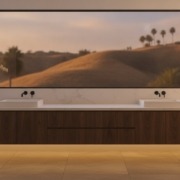
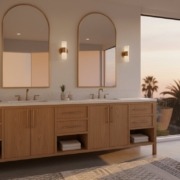
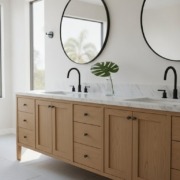
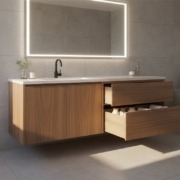
Traditional Bathroom Vanities in Los Angeles: The 2026 Design & Buying Guide
The most beautiful bathrooms in Los Angeles don’t follow trends; they honor them. If you’ve been searching for traditional bathroom vanities in Los Angeles and keep walking out of showrooms surrounded by nothing but sleek floating units and minimalist concrete, you already know the frustration. Your Craftsman bungalow in Pasadena or Spanish Colonial revival in Los Feliz deserves something more than a piece of furniture that looks borrowed from a hotel lobby.
You’re right to feel that way. A vanity isn’t just storage; it’s the architectural heartbeat of your bathroom, and in a city with as rich a residential heritage as LA, getting that choice wrong is genuinely costly. Cheap construction buckles under the humidity of a daily-use bathroom, and a style mismatch can quietly undermine the character of a home you’ve invested everything into.
This 2026 guide is here to change that experience entirely. You’ll learn exactly how to identify furniture-grade quality that holds up for decades, how to match vanity styles to LA’s most beloved home architectures, and where to see your options in person before you commit. Consider this your expert consultation, without the pressure.
Key Takeaways
- Traditional bathroom vanities in Los Angeles span a rich spectrum of styles — from Spanish Colonial to Craftsman — and choosing the right one means understanding how architectural heritage shapes the ideal vanity design for your specific home.
- Furniture-grade construction isn’t just a luxury label; in LA’s high-humidity daily-use bathrooms, solid wood frames and soft-close hardware are the difference between a vanity that lasts decades and one that disappoints within years.
- The single vs. double sink decision goes beyond personal preference — vanity size directly affects your bathroom’s visual weight, and the right choice depends on both your morning routine and the proportions of your space.
- Seeing a vanity in person before purchasing is one of the most important steps you can take, and Milan Gallery’s Sun Valley showroom — with over 300 models on display — makes that hands-on evaluation possible in one visit.
- Expert guidance from consultants who genuinely understand the Los Angeles remodeling market can save you from costly style mismatches and help you invest confidently in a piece your home will carry beautifully for years to come.
Defining the Traditional Aesthetic for Los Angeles Homes
Walk into any bathroom showroom in Los Angeles and you’ll hear the word “traditional” used loosely, sometimes to describe anything that isn’t a floating slab of concrete. But genuine traditional design is a specific visual language, and understanding it fluently is the first step toward choosing a vanity that actually belongs in your home rather than simply occupying space in it.
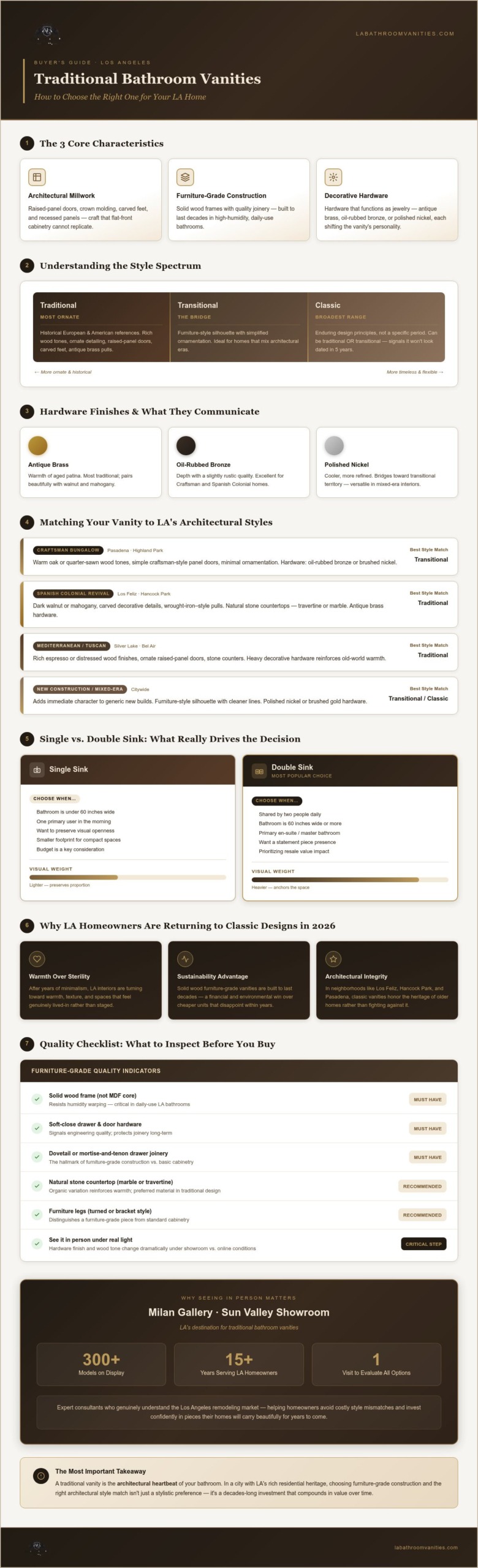
At its core, a traditional bathroom vanity is defined by three non-negotiable characteristics: architectural millwork, furniture-grade construction, and hardware that functions as decorative jewelry rather than an afterthought. These aren’t stylistic preferences; they’re structural commitments that separate a piece of furniture from a piece of cabinetry—a standard of bespoke excellence mirrored by Broadway Kitchens in the world of luxury kitchen design. That distinction matters enormously in a city where homes carry genuine architectural identity.
It’s also worth clarifying the vocabulary, because the terms “Traditional,” “Transitional,” and “Classic” get used interchangeably in showrooms and online listings when they actually describe meaningfully different things:
- Traditional leans into historical European and American design references, with ornate detailing, rich wood tones, and decorative hardware. Think raised-panel doors, carved feet, and antique brass pulls.
- Transitional bridges the gap between traditional warmth and modern restraint. It keeps the furniture-style silhouette but simplifies the ornamentation, making it a strong fit for homes that mix architectural eras.
- Classic is the broadest category, referring to enduring design principles rather than a specific historical period. A classic vanity can be traditional or transitional; the label simply signals that it won’t look dated in five years.
The Anatomy of a Classic Vanity
The millwork is where traditional design earns its reputation. Recessed panel doors, crown molding along the top rail, and carved or turned furniture legs communicate a level of craft that flat-front cabinetry simply can’t replicate. Natural stone countertops, particularly marble and travertine, are the dominant surface choice because their organic variation reinforces the warmth that defines the style. For wood species, darker tones like walnut, mahogany, and espresso-stained oak are perennial favorites because they anchor a bathroom visually without competing with tile or fixtures.
Hardware is the finishing argument. Antique brass brings the warmth of aged patina, oil-rubbed bronze adds depth and a slightly rustic quality, and polished nickel offers a cooler, more refined alternative that bridges toward transitional territory. The right hardware choice can shift a vanity’s entire personality, which is why seeing it in person, under real light, matters so much.
Why LA Homeowners are Returning to Classic Designs in 2026
There’s a quiet but unmistakable shift happening in how Los Angeles residents are thinking about their interiors. After years of sterile minimalism, the conversation has turned toward warmth, texture, and spaces that feel genuinely lived-in rather than staged. A traditional vanity answers that desire directly. It adds immediate character to new construction that might otherwise feel generic, and it honors the architectural heritage of older homes in neighborhoods like Los Feliz, Hancock Park, and Pasadena.
There’s also a sustainability argument that rarely gets made loudly enough. Furniture-grade traditional vanities, built from solid wood with quality joinery, are designed to last decades rather than years. That longevity is both an environmental and financial advantage. When you’re searching for traditional bathroom vanities in Los Angeles, you’re not just choosing a style; you’re choosing a standard of construction that compounds in value over time. That’s a principle Milan Gallery has built its entire approach around, with over 15 years of helping LA homeowners make investments their homes will carry beautifully for years to come.
Key Features of High-Quality Traditional Vanities
Knowing what you want stylistically is only half the equation. The other half is understanding what separates a vanity that performs beautifully for twenty years from one that starts showing its weaknesses within three. For anyone seriously evaluating traditional bathroom vanities in Los Angeles, construction quality isn’t a secondary concern — it’s the primary one.
Solid Wood vs. Engineered Materials
Furniture-grade construction is a specific standard: it means dovetail joints, solid wood frames, and assembly methods borrowed from fine furniture-making rather than cabinet manufacturing. That distinction carries real consequences in a bathroom environment.
Los Angeles bathrooms cycle through humidity daily. Morning showers, steam, and temperature shifts create conditions that expose weak materials quickly. Particle board swells. Low-grade MDF delaminates at the edges. Many online listings obscure this by burying “solid wood frame” language in spec sheets while the door panels, drawer boxes, and interior shelving are engineered composites. Reading the fine print matters enormously here.
The gold-standard species for traditional vanities are solid oak, birch, and maple. Each offers a different grain character, but all three share a density and dimensional stability that holds up under sustained moisture exposure. When solid wood isn’t practical for every component — particularly on large door panels where solid wood can move with seasonal humidity — high-grade veneers over a stable substrate are the correct solution. The key word is “high-grade”: a quality veneer applied with precision prevents warping and maintains the visual richness of natural wood grain without the expansion risk of a wide solid panel.
Ornamentation and Hardware Details
The base of a traditional vanity does more work than most homeowners realize. Bun feet elevate the piece off the floor, making cleaning underneath straightforward and giving the vanity a genuine furniture-like presence. Plinth bases, which sit flush to the floor, offer a heavier, more anchored look that suits larger bathrooms well but can make mopping a minor frustration over time. Neither is universally superior; the right choice depends on your floor material, your cleaning habits, and the visual weight you want the vanity to carry.
Hardware finish coordination is where many otherwise well-planned bathrooms lose their coherence. Your faucet finish and your cabinet hardware should speak the same language. Antique brass pulls paired with a polished chrome faucet create a quiet tension that reads as oversight rather than intention. Commit to one metal family throughout the vanity zone, and the result feels considered rather than assembled.
Countertop selection follows the same logic. Carrara marble brings luminous warmth and pairs naturally with antique brass or oil-rubbed bronze. Granite offers deeper patterning with superior stain resistance. Engineered quartz gives you the visual softness of natural stone with more predictable maintenance. All three are appropriate pairings for traditional cabinetry; the right choice depends on how much daily wear your countertop will absorb.
On the sink question: integrated undermount sinks maintain clean sightlines and keep the countertop surface easy to wipe down, making them the practical favorite for traditional vanities in daily-use bathrooms. Vessel sinks can work in a traditional context, but they require careful styling — a vessel that reads as sculptural rather than rustic can feel mismatched against raised-panel cabinetry. Before finalizing any of these decisions, it’s worth understanding how your sink configuration affects overall vanity sizing; a detailed breakdown is available in this guide to bathroom vanity sizes.
Soft-close hinges and drawer glides deserve a specific mention because they’re often treated as a premium upgrade when they should be a baseline expectation on any furniture-grade piece. Beyond the obvious comfort benefit, soft-close hardware reduces the cumulative stress on door frames and drawer boxes — which directly extends the structural life of the vanity in a high-use bathroom.
If you want to evaluate these construction details firsthand rather than interpreting spec sheets, Milan Gallery’s showroom gives you the opportunity to open drawers, examine joinery, and feel the weight of hardware on over 300 models before committing to a single one.
Choosing Between Single and Double Sink Traditional Vanities
The single vs. double sink question sounds straightforward until you’re standing in a showroom trying to picture your actual morning. Two adults, one bathroom, a 7:15 AM departure time. That mental exercise tells you more than any spec sheet will.
But this decision carries design consequences that extend well beyond scheduling convenience. Vanity size directly shapes the visual weight of your bathroom, and in a traditionally styled space, getting the proportions wrong is immediately noticeable. A 72-inch double vanity in a compact bathroom doesn’t read as generous; it reads as cramped. A 36-inch single in a sprawling master suite doesn’t read as restrained; it reads as unfinished.
The Charm of the Traditional Single Sink Vanity
Smaller bathrooms deserve serious design attention, not compromise. A 30-inch or 36-inch traditional single sink vanity is the ideal solution for guest baths and powder rooms, where the goal is impact rather than utility. Raised-panel doors, carved feet, and a well-chosen marble top can make a compact powder room feel like the most memorable room in the house. These are the spaces that guests actually comment on.
For homeowners who want to make a genuine statement in a slightly larger single-sink bathroom, a 48-inch bathroom vanity hits a particularly satisfying sweet spot. It’s large enough to anchor the room visually, generous enough to offer real counter space and storage, and still proportioned for a bathroom that doesn’t have the square footage to support two sinks. In many traditionally styled LA homes, this size is the most versatile option available.
Single sink configurations also keep plumbing costs straightforward, which matters in older homes where adding a second drain line means opening walls.
Master Suite Grandeur: 60-Inch to 84-Inch Double Vanities
A 72-inch double sink vanity is where traditional bathroom design reaches its most satisfying expression. Symmetry is a core principle of classical aesthetics, and a well-designed double vanity delivers it naturally: matching mirrors, paired hardware, balanced drawer pulls on either side of a shared countertop. In a master bathroom with adequate square footage, the result feels genuinely architectural rather than simply functional.
For larger master suites, 84-inch double vanities create a full furniture-wall effect that commands the room. The storage capacity is substantial, and the visual presence is undeniable.
One practical consideration worth taking seriously: older Los Angeles homes, particularly pre-1960s Craftsman and Spanish Colonial properties, often have plumbing configurations that make adding a second sink more involved than buyers anticipate. A second drain line, additional supply lines, and potentially updated venting can add meaningful cost to a double sink installation. Getting a plumber’s assessment before finalizing your vanity choice is a step that pays for itself.
On the resale side, master bathrooms with double sink vanities are consistently cited by LA real estate professionals as a feature buyers expect at higher price points. In neighborhoods like Hancock Park or Los Feliz, where buyers are comparing similarly priced homes with strong architectural character, a beautifully appointed double vanity in a master bath is a genuine differentiator.
When you’re evaluating traditional bathroom vanities in Los Angeles across this full size range, seeing the actual footprints in person matters. Milan Gallery’s Sun Valley showroom carries single and double sink models from 30 inches through 84 inches, so you can stand in front of each size and make a proportional judgment that no online rendering can replicate.
Matching Your Vanity to LA’s Historic Architectural Styles
Los Angeles is one of the few cities in America where you can drive three blocks and move through an entirely different architectural era. Spanish Colonial revivals in Pasadena, Craftsman bungalows in Burbank, Victorian-era Victorians in Echo Park, Hollywood Regency estates in the hills — each of these homes carries a distinct visual grammar, and the best traditional bathroom vanities in Los Angeles honor that grammar rather than contradict it. Getting this match right is what separates a bathroom that feels authentically resolved from one that feels like a catalog page dropped into someone else’s house.
The Spanish Colonial Influence
Spanish Colonial and Mediterranean-style homes — concentrated in neighborhoods like Santa Monica, Pasadena, and Los Feliz — call for vanities with depth, warmth, and a sense of age. Distressed wood finishes work beautifully here precisely because they don’t try to look new; they echo the hand-plastered walls and worn-tile floors that give these homes their soul. Dark walnut vanities anchor the aesthetic of 1920s Los Angeles architecture with an authority that lighter finishes simply can’t replicate.
For hardware, wrought-iron-inspired pulls and hinges in oil-rubbed bronze or matte black carry the right visual weight. Pair these with terracotta floor tiles and a hand-painted Talavera backsplash, and the bathroom reads as a continuation of the home rather than a renovation layered on top of it. Avoid anything with chrome or brushed nickel in these spaces; the coolness of those metals pulls against the warmth the style demands.
Craftsman Authenticity in Burbank and Glendale
Craftsman design is built on a principle of honesty: materials should look like what they are, and construction details should be visible rather than hidden. For vanities in Craftsman bungalows, that means quarter-sawn oak with visible grain, simple recessed-panel or flat-panel doors without ornate carving, and Mission-style hardware in oil-rubbed bronze or antique copper. Anything fussy or decorative reads as a style violation in these interiors.
Original bungalow bathrooms in Burbank and Glendale tend to be compact, which makes the 36-inch or 42-inch single sink vanity the most practical choice. Preserving floor space in these layouts isn’t just about comfort; it’s about respecting the proportions the architect intended. Crowding a small Craftsman bathroom with an oversized vanity defeats the purpose entirely. If you’re sourcing materials for the full bathroom renovation alongside your vanity search, this guide to bathroom supply stores in Los Angeles covers where to find quality fixtures and tile that complement the style.
Victorian, Queen Anne, and Hollywood Regency
Victorian and Queen Anne homes reward maximalism. White marble countertops, high-gloss painted cabinetry in soft whites or deep jewel tones, and polished nickel hardware create the layered richness these interiors expect. Ornate carved feet, detailed crown molding along the top rail, and porcelain undermount sinks reinforce the period authenticity without veering into costume territory.
Each of these styles demands a different eye, and seeing the actual finishes under real light makes all the difference. Visit Milan Gallery’s Sun Valley showroom to evaluate wood tones, hardware finishes, and countertop pairings across more than 300 models before committing to your choice.
Milan Gallery: LA’s Best for Traditional Vanities
Every decision covered in this guide — wood species, hardware finish, architectural style matching, vanity sizing — reaches its natural conclusion the moment you walk into a showroom and see a piece in person. Photographs flatten depth. Spec sheets can’t communicate the weight of a drawer pull or the warmth of a walnut finish under natural light. That gap between researching and actually knowing is exactly what Milan Gallery’s Sun Valley showroom exists to close.
The Milan Gallery Showroom Experience
The Sherman Way showroom carries over 300 models on the floor, spanning the full range of traditional, transitional, and modern styles. That breadth isn’t accidental. It means you can stand in front of a raised-panel walnut vanity, then step three feet to the left and compare it directly against a Shaker-style oak piece with Mission hardware, under the same lighting conditions, in the same visit. That kind of side-by-side comparison is genuinely impossible to replicate online, and for anyone serious about finding traditional bathroom vanities in Los Angeles that actually belong in their home, it’s the most valuable hour you’ll spend in the entire process.
Consultants at the showroom understand the Los Angeles remodeling market specifically, not generically. They know the difference between what works in a compact Craftsman bathroom in Burbank and what a sprawling Hollywood Regency master suite demands. That local fluency translates into practical guidance that saves you from costly mismatches before they happen. If you’ve found something you love online, ask about redeeming your online discount for in-store purchases when you visit.
Beyond the Vanity: Completing Your Bathroom
A traditional vanity doesn’t live in isolation. The fixtures, hardware, and statement pieces surrounding it either reinforce the design or quietly undermine it. Milan Gallery carries the full range of products needed to coordinate a complete bathroom remodel rather than assembling one piece at a time from different sources:
- Smart toilets: Modern functionality doesn’t have to break a traditional aesthetic. The smart toilet options available at Milan Gallery can be selected to complement rather than compete with classic cabinetry.
- Freestanding bathtubs: In a master bathroom with a strong traditional vanity, a freestanding bathtub is the natural centerpiece that completes the room’s architectural story.
- Shower systems, faucets, and LED mirrors: Coordinating these finishes through a single source ensures the metal families stay consistent throughout the space, which is the detail that separates a bathroom that feels designed from one that feels assembled.
That coordination is where Milan Gallery’s consultants earn their value most visibly. Rather than leaving you to reconcile spec sheets from five different vendors, they help you build a coherent bathroom from a single conversation. Fifteen years of helping Los Angeles homeowners navigate exactly these decisions means the guidance is specific, honest, and grounded in what actually works in real homes across this city.
If you’re ready to move from research to reality, visit Milan Gallery’s showroom on Sherman Way and see what over 300 models of traditional bathroom vanities in Los Angeles actually look like in person. Bring your floor plan, bring your inspiration photos, and let the conversation take it from there.
Your Next Step Toward a Bathroom That Truly Belongs
Finding the right traditional bathroom vanities in Los Angeles comes down to three things: understanding the construction quality that holds up in daily use, matching the style to your home’s architectural DNA, and seeing your options in person before committing. No online rendering replaces standing in front of a piece and opening its drawers.
That’s exactly what Milan Gallery makes possible. With 15+ years serving LA homeowners, over 300 models on the showroom floor, and a reputation as a voted top bathroom supply store in Los Angeles, the team brings genuine local expertise to every conversation. Whether you’re furnishing a compact Craftsman guest bath or a sprawling master suite, the right vanity is waiting to be found.
Don’t settle for a bathroom that almost feels right. Browse our exclusive traditional vanity collection and visit our Los Angeles showroom today and walk away with a choice you’ll feel confident about for years to come.
Frequently Asked Questions About Traditional Bathroom Vanities in Los Angeles
What is the best material for a traditional bathroom vanity in the Los Angeles climate?
Solid oak, birch, and maple are the strongest choices for Los Angeles bathrooms because their density resists the daily humidity cycling that comes from showers and steam. These species hold their dimensions reliably under sustained moisture exposure, which is the primary stress point in any daily-use bathroom. Avoid particle board or low-grade MDF as primary structural components; both swell and delaminate faster than most homeowners expect.
Where solid wood panels aren’t practical, high-grade veneers over a stable substrate are the correct compromise. The key is reading the full spec sheet rather than relying on marketing language. A vanity described as “solid wood” may still use engineered composites for drawer boxes and interior shelving, so confirming every component matters before you buy.
Do traditional vanities provide more storage than modern floating vanities?
Generally, yes. Floor-standing traditional vanities use the full height of the cabinet rather than suspending the box mid-wall, which typically means deeper drawer stacks, taller door compartments, and more usable interior volume. The furniture-style construction also allows for wider drawers with dovetail joinery, which holds up better under the weight of daily-use items than the thinner drawer boxes common in floating designs.
That said, storage capacity varies more by vanity size than by style category. A 48-inch traditional single sink vanity will always outperform a 36-inch floating unit on storage, regardless of construction style. If maximizing storage is a priority, focus on the size range first and the style second.
Can I install a double sink vanity in a small Los Angeles bathroom?
It’s possible, but the proportions need honest evaluation before you commit. A double sink configuration typically starts at 60 inches wide, and in a bathroom under roughly 80 square feet, that footprint can make the space feel crowded rather than generous. The visual weight of a large vanity in a compact room reads as cramped, which works against the design goals of a traditionally styled space.
For smaller bathrooms where two sinks feel necessary, a 60-inch double sink vanity is the minimum size that functions comfortably, and it requires careful planning around door clearance and traffic flow. In many cases, a well-chosen 48-inch single sink vanity delivers more visual balance and practical comfort than a double sink that technically fits but dominates the room.
What are the most popular traditional vanity colors in LA for 2026?
Warm wood tones are leading the conversation in 2026, with walnut and espresso-stained oak appearing consistently in traditional bathroom renovations across Los Angeles. These deeper finishes anchor a bathroom visually and pair naturally with the natural stone countertops and antique brass hardware that define the current traditional aesthetic. White and off-white painted finishes remain strong, particularly in Victorian-inspired and Hollywood Regency bathrooms where a lacquered cabinet surface adds a layer of refinement.
Deep navy and forest green are gaining traction as accent choices in traditionally styled master bathrooms, typically paired with unlacquered brass hardware and Carrara marble tops. These bolder colors work best in larger bathrooms where the vanity can carry the visual weight without overwhelming the room.
How do I measure my bathroom to ensure a traditional vanity fits properly?
Start with three measurements: the width of the wall where the vanity will sit, the depth available from that wall to any obstruction like a toilet or door swing, and the ceiling height if you’re planning any upper cabinetry or mirrors. Standard traditional vanity depths run between 18 and 22 inches, so confirm you have at least 21 inches of clear floor space from the wall to maintain comfortable use. Always measure twice and account for baseboard trim, which can reduce usable wall width by half an inch or more on each side.
One step many homeowners skip is checking door clearance in both directions. A vanity drawer that opens into a swinging bathroom door creates a daily frustration that no amount of beautiful millwork will fix. Bring your floor measurements to the Milan Gallery showroom and the consultants there can help you evaluate which size options work within your specific layout.
Does Milan Gallery offer delivery for traditional vanities in the San Fernando Valley?
Milan Gallery’s showroom is located on Sherman Way in Sun Valley, which places it directly within the San Fernando Valley. For specific delivery options, service areas, and any associated logistics, it’s best to contact the showroom team directly, as availability and scheduling can vary. Confirming those details in person or by phone ensures you get accurate, current information rather than relying on assumptions.
Should I choose a marble or quartz top for my traditional vanity?
Marble brings organic warmth and luminous depth that pairs beautifully with antique brass hardware and raised-panel cabinetry, making it the more visually compelling choice for a traditionally styled bathroom. Its natural variation is part of its appeal. The trade-off is maintenance; marble is porous and can stain or etch from acidic products if it isn’t sealed regularly and treated with care in daily use.
Engineered quartz delivers a similar visual softness with significantly more resistance to staining, etching, and daily wear. For a high-traffic master bathroom used by multiple people, quartz is often the more practical long-term investment. If the bathroom sees lighter use, such as a guest bath or powder room, marble’s character is hard to match and the maintenance burden is minimal.
How do I match my traditional vanity to a historic Craftsman home?
Craftsman design rewards restraint. Quarter-sawn oak with visible grain, simple recessed-panel or flat-panel doors without ornate carving, and Mission-style hardware in oil-rubbed bronze or antique copper are the defining elements. Avoid anything with decorative scrollwork or carved feet; Craftsman interiors are built on the principle that construction details should be honest and visible rather than embellished. The right traditional bathroom vanities in Los Angeles for a Craftsman home look handcrafted, not ornate.
Size matters as much as style in these homes. Original Craftsman bungalows in neighborhoods like Burbank and Glendale tend toward compact bathroom layouts, so a 36-inch or 42-inch single sink vanity typically preserves the proportions the architect intended. Crowding a small Craftsman bathroom with an oversized piece is one of the most common and costly mistakes in this style of renovation.