Posts

Freestanding Bathroom Vanities: The Ultimate 2026 Los Angeles Design Guide

Freestanding Bathroom Vanities: The Ultimate 2026 Los Angeles Design Guide

What if your morning routine felt less like a chore and more like a private retreat at a five-star hotel right here in Los Angeles? In the world of high-end home design, freestanding bathroom vanities have evolved from simple cabinets into the definitive statement pieces of the 2026 Los Angeles remodel. You likely already know that a bathroom should be a sanctuary, yet the pressure of choosing the right fixture can feel paralyzing. Between the endless scroll of online options that might arrive looking nothing like their photos and the technical anxiety of fitting modern plumbing into a charming but aging Los Angeles residence, it’s easy to feel overwhelmed by the process.

We understand that you’re looking for more than just a sink; you want a durable investment that will wow your guests while standing up to the rigors of daily life. This guide will show you how to balance the latest Organic Modernism trends with the practical requirements of the 2026 California Building Standards Code. We’ll explore how to maximize your storage without sacrificing floor space and how to select materials like white oak or quartz that ensure your vanity remains timeless rather than dated. From navigating Title 24 compliance to finding that perfect furniture-style silhouette in our Sun Valley showroom, you’re about to discover how to anchor your bathroom with confidence and style.

Key Takeaways

  • Understand why the sophisticated “furniture-look” of modern freestanding bathroom vanities has become the premier choice for homeowners seeking to ground their space with a sense of architectural permanence and luxury.
  • Identify the specific material combinations, such as solid wood frames and quartz tops, that offer the ultimate balance of aspirational beauty and long-term durability in the unique climate of Los Angeles.
  • Evaluate the practical storage benefits and plumbing requirements of freestanding designs versus floating models to ensure your selection perfectly accommodates your family’s daily routine.
  • Gain expert insights into sizing and clearance planning for units ranging from 30 to 84 inches, ensuring your new vanity integrates seamlessly with your existing shower and doorway layouts.
  • Learn how a personal consultation and hands-on material inspection at a local showroom can provide the aesthetic validation needed to transform your renovation into a successful, high-value investment.

Have you ever noticed how a single piece of furniture can completely anchor a room’s identity? That’s exactly what freestanding bathroom vanities are doing for Los Angeles homes this year. Unlike a standard bathroom cabinet that’s bolted into the studs and sealed with heavy caulk, a freestanding unit is a floor-set system that supports its own weight. This structural independence creates a sense of permanence and architectural intent that built-in options often lack.

In 2026, we’re seeing a massive shift toward “Organic Modernism” in Southern California. Homeowners are moving away from the cold, clinical looks of the past decade. Instead, they’re choosing pieces that feel like heirloom furniture, often visiting our Sun Valley showroom to experience the tactile quality of solid wood and quartz in person. Whether you’re updating a guest powder room to impress your next dinner party or redesigning a master suite for your own relaxation, the right vanity provides the aesthetic validation that makes a house feel like a curated home. It’s a statement of style that tells your guests you value both form and function.

Freestanding vs. Built-in Cabinetry

Why settle for a fixed box when you can have a piece of art? If you’re working with a unique LA floor plan, perhaps in a historic Mid-City Craftsman or a modern Hollywood Hills glass house, freestanding bathroom vanities offer superior flexibility. You don’t have to worry about wall-load bearing requirements in the same way you do with floating styles, which is a significant relief for those with older plumbing or plaster walls. Consider these advantages over built-in options:

  • Ease of Access: Repairing floor plumbing is often simpler when you aren’t fighting against a permanent wall-to-wall structure.
  • Future-Proofing: Swapping a freestanding unit is significantly easier during a future refresh than tearing out custom cabinetry.
  • Visual Space: Units with legs reveal more of the floor, which can make a small bathroom feel larger and airier.

This structural independence means your design isn’t locked in forever, allowing your home to evolve with your tastes as trends shift toward more personalized spaces.

The Aesthetic Evolution of Floor-Mount Designs

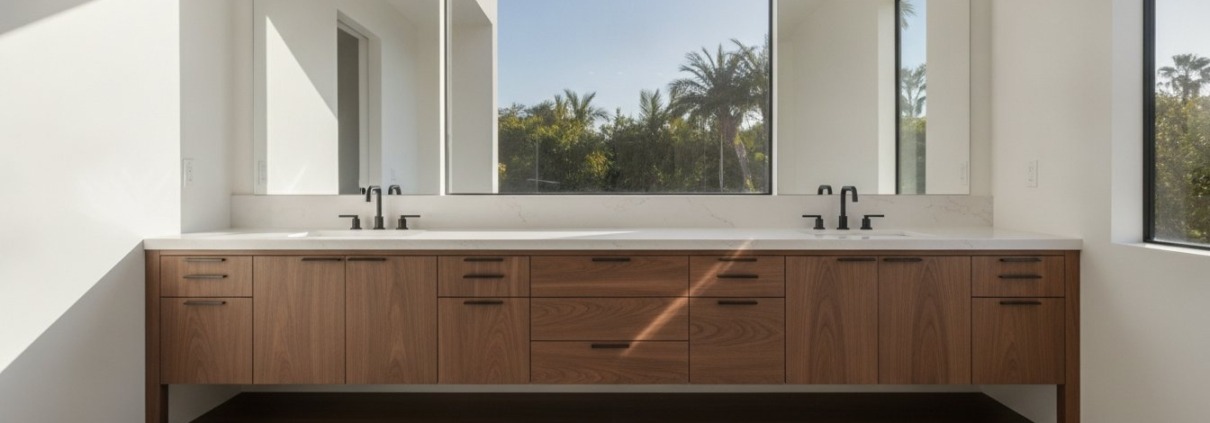
Forget the bulky, skirted vanities of the past. Today’s floor-mount designs have evolved into sleek, sophisticated silhouettes featuring minimalist legs and open shelving that allow light to flow through the room. They anchor the visual weight of the space without making it feel cramped or dark. We’ve seen a surge in demand for natural wood finishes like white oak and walnut that bring warmth to the bathroom. The furniture-style vanity serves as the essential bridge between classic craftsmanship and modern utility, offering a sophisticated alternative to standard cabinetry. By choosing a design that stands on its own, you create a focal point that feels intentional rather than just functional.

Choosing the Right Materials and Finishes for Longevity

How do you ensure your investment doesn’t just look beautiful on day one, but stays pristine for a decade or more? In a climate as varied as Los Angeles, where coastal salt air in Santa Monica meets the dry, intense heat of the San Fernando Valley, material selection is everything. When you invest in freestanding bathroom vanities, you’re choosing a piece that will face daily exposure to steam, moisture, and various cleaning agents. While many big-box retailers rely on thin veneers or particle board that swell and peel within just a few years, we believe in high-impact materials that offer both material resilience and long-term performance.

Whether you’re looking for double sink models for a master suite or compact single units for a guest bath, the best freestanding bathroom vanities rely on a combination of premium wood and stone. Beyond the cabinet itself, the hardware and internal mechanisms define the daily user experience. We consider soft-close drawer glides and door hinges a non-negotiable standard for any luxury remodel. These features don’t just prevent annoying slams; they protect the structural integrity of the vanity by reducing mechanical stress over thousands of uses.

The Resilience of Solid Wood Frames

Solid wood remains the undisputed gold standard for high-traffic family bathrooms because it offers a structural integrity that engineered alternatives simply can’t replicate. It’s naturally resistant to the warping and moisture-related expansion that can ruin cheaper cabinets in humid environments. Beyond the sheer durability, there’s a tactile feel of quality in a solid wood frame that provides the aesthetic validation discerning homeowners crave. This focus on longevity is also a core component of aging-in-place home modifications, as sturdy, reliable fixtures reduce the need for frequent, stressful repairs as the years go by. It’s about building a home that lasts as long as your memories do.

Premium Countertop Trends for 2026

The surfaces you touch every day should be as resilient as they are luxurious. For 2026, white quartz has emerged as the clear favorite in LA design because it provides the stunning, high-end look of marble without the high-maintenance sealing and staining issues. If you’re aiming for an ultra-modern, minimalist look, reinforced acrylic tops offer a seamless, easy-to-clean aesthetic that feels incredibly fresh. Many of our clients choose to coordinate their vanity top with their freestanding bathtubs to create a unified, spa-like master suite that impresses every guest. Don’t forget to select hardware finishes like brushed nickel, champagne gold, or matte black that are specifically treated to withstand the test of time. If you’re ready to see these textures for yourself, you can explore our curated collection online before visiting our Sun Valley showroom to feel the difference in quality firsthand.

Freestanding Bathroom Vanities: The Ultimate 2026 Los Angeles Design Guide

Freestanding vs. Floating Vanities: Which Suits Your LA Home?

Are you torn between the sleek, gravity-defying look of a wall-mount and the timeless, grounded presence of freestanding bathroom vanities? It’s the ultimate dilemma for any homeowner aiming to strike that perfect balance between aspirational luxury and practical durability. While both styles offer distinct aesthetic rewards, the decision often comes down to the specific architectural bones of your Los Angeles property and how much storage your household truly requires to stay organized. For many of our clients, the choice is an emotional one, balancing the excitement of a modern silhouette with the security of a reliable, long-term investment.

Freestanding units are the undisputed champions of storage capacity. Because these cabinets utilize the space all the way to the floor, they offer deep drawers and expansive shelving that floating models simply cannot match. This is particularly vital for busy families who need to tuck away everything from hair tools to extra linens. While floating units excel at creating visual “airiness,” they often sacrifice up to 30% of their potential storage volume. Beyond the look, installation is a key differentiator; freestanding bathroom vanities sit firmly on the floor, making them much easier to install in older LA homes where wall studs might not be perfectly aligned or reinforced for heavy loads.

Maintenance is another factor to weigh. While some homeowners fear “dust bunnies” under furniture legs, modern designs often provide enough clearance for a robotic vacuum or a quick sweep, ensuring your sanctuary stays as clean as a Sun Valley showroom display. This allows you to maintain a hygienic environment without sacrificing the “furniture-look” that adds so much character to the room.

The Case for Freestanding in Traditional LA Estates

Glendale and Sherman Oaks are home to some of the region’s most stunning architectural heritage, from Craftsman bungalows to Mediterranean estates. In these settings, a freestanding unit provides the “grounded elegance” that feels historically appropriate yet modern. By referencing our comprehensive guide on bathroom vanity sizes, you can find the perfect 48-inch or 72-inch model to anchor your master bath, providing the aesthetic validation that only a substantial piece of furniture can offer. These larger units serve as the social and functional heart of the bathroom, ensuring every family member has the space they need.

When to Choose Floating for Modern LA Residences

On the flip side, the minimalist aesthetic of a Santa Monica penthouse or a modern Encino hillside home often calls for a floating design. These wall-mount units create an uninterrupted floor line, which can make a small en-suite feel significantly larger. However, don’t underestimate the weight-bearing requirements. A floating vanity requires a professional assessment of your wall’s structural integrity, as it must support the combined weight of the solid wood frame, quartz top, and plumbing fixtures without sagging over time. If your walls aren’t up to the task, a sleek freestanding model with thin, modern legs can often provide a similar visual lightness with far less structural anxiety.

Sizing and Planning Your Freestanding Vanity Installation

Have you ever fallen in love with a piece of furniture only to find it doesn’t quite fit the physical or functional flow of your room? When selecting freestanding bathroom vanities, precision is the difference between a seamless luxury upgrade and a frustrating remodel. Because these units are structural statement pieces, they require a bit more foresight than a standard built-in cabinet. You aren’t just choosing a style; you’re coordinating with existing plumbing, door swings, and the daily movement of your household. Whether you’re looking at a compact 30-inch unit for a guest powder room or a sprawling 84-inch double vanity for a primary suite, the goal is to ensure the piece anchors the room without crowding it.

Beyond the width, don’t overlook the importance of standard vanity depth, which typically sits between 21 and 22 inches. This dimension is critical for maintaining comfortable movement in smaller LA bathrooms. You also need to account for the clearance of drawers and doors when they’re fully extended. If your vanity sits too close to a glass shower door or a toilet, you might find your morning routine feels cramped rather than restorative. It’s these small details that transform a functional fixture into a durable investment that increases your home’s value.

The Master Suite Standard: 60 to 72 Inch Double Vanities

For many homeowners, a 48 inch bathroom vanity represents the ultimate “sweet spot” for luxury single-sink setups, providing ample counter space for LED mirrors and designer accessories without the footprint of a double unit. However, if you’re planning for the “two-person morning rush,” a 60-inch or 72-inch double sink model is the gold standard. These larger sizes provide the aesthetic validation of a high-end spa while offering the maximum storage capacity needed for multi-person households. When you visit our Sun Valley showroom, you can stand in front of these units to truly feel how much elbow room you’ll have during your daily routine.

Common Installation Pitfalls to Avoid

One of the most frequent mistakes we see is failing to account for baseboard thickness. If you want your vanity to sit flush against the wall, those extra three-quarters of an inch of wood at the floor can create an unsightly gap or prevent the countertop from aligning correctly. Additionally, if you’re moving from a wall-mount to a freestanding design, you must ensure your existing wall-mounted faucets align with the height of your new furniture. To ensure a perfect fit, use this checklist to measure your rough-in plumbing height before you finalize your purchase:

  • Identify the vertical centerline of your existing drain and supply lines.
  • Measure the height from the finished floor to the center of the waste outlet.
  • Confirm the width between the hot and cold water supply valves.
  • Verify that the vanity’s back-panel opening or internal shelving won’t obstruct these connections.

If you’re ready to find the perfect dimensions for your space, we invite you to explore our size-specific collections and discover how a perfectly fitted vanity can redefine your bathroom’s social and functional identity.

Why leave your home’s aesthetic success to a tiny thumbnail on a digital screen? For more than 15 years, Milan Gallery Bathroom Vanities has been a dedicated partner to the Los Angeles remodeling community, providing the professional reassurance and local expertise you need to make confident decisions. We believe that your bathroom is a vital social space that deserves more than just functional fixtures. Our mission is to help you achieve the aesthetic validation that only a perfectly curated room can provide. Our inventory of freestanding bathroom vanities is carefully selected to offer exclusive designs that go far beyond the standard builder-grade options found at local big-box retailers, ensuring your home reflects your personal discernment.

Why a Local Los Angeles Showroom Matters

There is a specific kind of disappointment that comes when high-ticket furniture arrives looking nothing like its online photos. By visiting our Sun Valley showroom, you can completely avoid this “online vs. reality” anxiety while exploring one of the largest selections in the region. Seeing the true color of our walnut or white oak finishes and feeling the cool, polished surface of our premium quartz tops allows you to shop with absolute creative agency. We understand the pace of LA renovations, which is why we maintain immediate availability on our most popular sizes, including 36, 48, and 60-inch units. You don’t have to wait weeks for a shipment to arrive from across the country. You can see the quality with your own eyes and secure your investment today.

Your Partner in Aesthetic Validation

We don’t just sell cabinets; we act as a collaborative partner in your home improvement journey. Our expert design consultations are designed to help you bridge the gap between contemporary aesthetics and classic quality, ensuring every piece you select adds to the social and functional identity of your home. We can help you match your new vanity with high-end faucets, LED mirrors, and even the latest smart toilets to create a cohesive, modern environment that will impress every guest who walks through your door.

Whether you’re looking for a massive 84-inch double vanity to anchor a primary suite or a sleek single unit for a guest bath, we ensure every element works together to increase your home’s value and your own daily enjoyment. Our team is deeply invested in your domestic success, and we’re eager to prove the value of our time-tested materials to you. Visit Milan Gallery Bathroom Vanities in Sun Valley today to find your perfect freestanding vanity and experience the difference that 15 years of local pride and attentive customer service can make for your project.

Elevate Your Home with Timeless Design

Your journey toward a more luxurious, functional bathroom doesn’t have to end with research. By choosing a piece that balances aspirational beauty with the structural integrity of solid wood and quartz, you’re making a lasting investment in your home’s social and functional success. We’ve explored everything from the space-saving benefits of the 48-inch single sink to the expansive utility of double-sink master suites, yet the final step is seeing these textures and finishes in person.

At Milan Gallery Bathroom Vanities, we bring more than 15 years of expert guidance to every project, helping you navigate the complexities of LA remodels with professional reassurance. Our massive Sun Valley showroom is the ultimate destination for aesthetic validation, where you can touch our premium materials and visualize how they will anchor your space. We’re dedicated to transforming your shopping experience into an inspiring creative journey.

Browse Our Exclusive Freestanding Vanity Collection and take the first step toward a sanctuary that truly impresses your guests. Let our team help you find the perfect freestanding bathroom vanities to complete your vision and increase your home’s long-term value.

Frequently Asked Questions

Are freestanding vanities more expensive than wall-mounted ones?

Freestanding vanities often offer a more complete furniture look right out of the box, which can actually save you money compared to the structural reinforcement required for wall-mounted models. While the initial purchase price depends on the quality of the solid wood and stone you select, the installation of freestanding bathroom vanities is generally less labor-intensive. This makes them a highly cost-effective way to achieve an aspirational luxury look without hidden construction costs.

Can I install a freestanding vanity myself in my Los Angeles home?

While a handy homeowner can certainly tackle the placement, we always suggest consulting a professional to ensure your project meets the 2026 California Building Standards Code (Title 24). Any modification to your plumbing or electrical systems must be brought up to current code to protect your home’s value. A pro can also help navigate the tight plumbing clearances often found in historic Los Angeles bungalows, ensuring your beautiful new fixture functions as perfectly as it looks.

What is the best size for a master bathroom freestanding vanity?

Most Los Angeles master suites thrive with 60-inch or 72-inch double sink models. These sizes provide the perfect balance of personal space and aesthetic validation during the morning rush. If your floor plan allows, an 84-inch double vanity offers the ultimate in luxury storage and counter space. For smaller en-suites or guest rooms, a 48-inch single sink model remains the “sweet spot” for maintaining a high-end feel without overcrowding the room.

Do freestanding vanities come with the sink and countertop included?

Yes, most of our exclusive designs arrive as a complete package featuring the cabinet, a premium countertop, and an under-mount sink. This ensures that your quartz or reinforced acrylic top is perfectly fitted to the solid wood frame for a seamless look. We’ve found that providing a pre-matched set takes the guesswork out of your remodel, allowing you to focus on the fun part: choosing the hardware finishes and LED mirrors that reflect your personal style.

How do I clean under a freestanding bathroom vanity?

Cleaning under your vanity is much simpler than you might expect. Most modern furniture-style designs feature legs that provide several inches of clearance, allowing a slim microfiber mop or a robotic vacuum to pass through easily. This prevents the buildup of dust and keeps your sanctuary feeling fresh and hygienic. It’s a small maintenance trade-off for the “airier” visual impact and sophisticated silhouette that these floor-mount units bring to your bathroom environment.

Will a freestanding vanity work with my existing wall plumbing?

Absolutely, freestanding bathroom vanities are incredibly versatile and can typically accommodate existing wall plumbing with minor adjustments. Most units feature an open back or a removable panel designed specifically for this purpose. This makes them a fantastic choice for refreshing older LA homes where you want to avoid the high cost of rerouting pipes through the floor. It’s a practical way to get that high-end furniture look with minimal structural headaches.

What are the most popular vanity colors for LA homes in 2026?

We’re seeing a vibrant shift toward Organic Modernism in 2026. While natural wood finishes like white oak and walnut remain timeless favorites, homeowners are increasingly choosing warm, earthy palettes. Sage green, soft terracotta, and warm grays have replaced the stark, cool grays of the past decade. These colors create a spa-like atmosphere that feels both grounded and inviting, perfectly matching the relaxed but sophisticated lifestyle of our specific Southern California region.

Are solid wood vanities better than MDF for Los Angeles bathrooms?

Solid wood is undoubtedly the superior choice for the unique humidity levels found in Los Angeles bathrooms. Unlike MDF or particle board, which can swell and peel when exposed to steam, solid wood offers the material resilience needed for long-term performance. It provides a structural integrity and a premium tactile feel that engineered alternatives simply can’t match. Investing in quality wood ensures your vanity remains a beautiful, durable fixture for your home for decades to come.

Traditional Bathroom Vanities in Los Angeles: The 2026 Design & Buying Guide

The most beautiful bathrooms in Los Angeles don’t follow trends; they honor them. If you’ve been searching for traditional bathroom vanities in Los Angeles and keep walking out of showrooms surrounded by nothing but sleek floating units and minimalist concrete, you already know the frustration. Your Craftsman bungalow in Pasadena or Spanish Colonial revival in Los Feliz deserves something more than a piece of furniture that looks borrowed from a hotel lobby.

You’re right to feel that way. A vanity isn’t just storage; it’s the architectural heartbeat of your bathroom, and in a city with as rich a residential heritage as LA, getting that choice wrong is genuinely costly. Cheap construction buckles under the humidity of a daily-use bathroom, and a style mismatch can quietly undermine the character of a home you’ve invested everything into.

This 2026 guide is here to change that experience entirely. You’ll learn exactly how to identify furniture-grade quality that holds up for decades, how to match vanity styles to LA’s most beloved home architectures, and where to see your options in person before you commit. Consider this your expert consultation, without the pressure.

Key Takeaways

  • Traditional bathroom vanities in Los Angeles span a rich spectrum of styles — from Spanish Colonial to Craftsman — and choosing the right one means understanding how architectural heritage shapes the ideal vanity design for your specific home.
  • Furniture-grade construction isn’t just a luxury label; in LA’s high-humidity daily-use bathrooms, solid wood frames and soft-close hardware are the difference between a vanity that lasts decades and one that disappoints within years.
  • The single vs. double sink decision goes beyond personal preference — vanity size directly affects your bathroom’s visual weight, and the right choice depends on both your morning routine and the proportions of your space.
  • Seeing a vanity in person before purchasing is one of the most important steps you can take, and Milan Gallery’s Sun Valley showroom — with over 300 models on display — makes that hands-on evaluation possible in one visit.
  • Expert guidance from consultants who genuinely understand the Los Angeles remodeling market can save you from costly style mismatches and help you invest confidently in a piece your home will carry beautifully for years to come.

Defining the Traditional Aesthetic for Los Angeles Homes

Walk into any bathroom showroom in Los Angeles and you’ll hear the word “traditional” used loosely, sometimes to describe anything that isn’t a floating slab of concrete. But genuine traditional design is a specific visual language, and understanding it fluently is the first step toward choosing a vanity that actually belongs in your home rather than simply occupying space in it.

At its core, a traditional bathroom vanity is defined by three non-negotiable characteristics: architectural millwork, furniture-grade construction, and hardware that functions as decorative jewelry rather than an afterthought. These aren’t stylistic preferences; they’re structural commitments that separate a piece of furniture from a piece of cabinetry—a standard of bespoke excellence mirrored by Broadway Kitchens in the world of luxury kitchen design. That distinction matters enormously in a city where homes carry genuine architectural identity.

It’s also worth clarifying the vocabulary, because the terms “Traditional,” “Transitional,” and “Classic” get used interchangeably in showrooms and online listings when they actually describe meaningfully different things:

  • Traditional leans into historical European and American design references, with ornate detailing, rich wood tones, and decorative hardware. Think raised-panel doors, carved feet, and antique brass pulls.
  • Transitional bridges the gap between traditional warmth and modern restraint. It keeps the furniture-style silhouette but simplifies the ornamentation, making it a strong fit for homes that mix architectural eras.
  • Classic is the broadest category, referring to enduring design principles rather than a specific historical period. A classic vanity can be traditional or transitional; the label simply signals that it won’t look dated in five years.

The Anatomy of a Classic Vanity

The millwork is where traditional design earns its reputation. Recessed panel doors, crown molding along the top rail, and carved or turned furniture legs communicate a level of craft that flat-front cabinetry simply can’t replicate. Natural stone countertops, particularly marble and travertine, are the dominant surface choice because their organic variation reinforces the warmth that defines the style. For wood species, darker tones like walnut, mahogany, and espresso-stained oak are perennial favorites because they anchor a bathroom visually without competing with tile or fixtures.

Hardware is the finishing argument. Antique brass brings the warmth of aged patina, oil-rubbed bronze adds depth and a slightly rustic quality, and polished nickel offers a cooler, more refined alternative that bridges toward transitional territory. The right hardware choice can shift a vanity’s entire personality, which is why seeing it in person, under real light, matters so much.

Why LA Homeowners are Returning to Classic Designs in 2026

There’s a quiet but unmistakable shift happening in how Los Angeles residents are thinking about their interiors. After years of sterile minimalism, the conversation has turned toward warmth, texture, and spaces that feel genuinely lived-in rather than staged. A traditional vanity answers that desire directly. It adds immediate character to new construction that might otherwise feel generic, and it honors the architectural heritage of older homes in neighborhoods like Los Feliz, Hancock Park, and Pasadena.

There’s also a sustainability argument that rarely gets made loudly enough. Furniture-grade traditional vanities, built from solid wood with quality joinery, are designed to last decades rather than years. That longevity is both an environmental and financial advantage. When you’re searching for traditional bathroom vanities in Los Angeles, you’re not just choosing a style; you’re choosing a standard of construction that compounds in value over time. That’s a principle Milan Gallery has built its entire approach around, with over 15 years of helping LA homeowners make investments their homes will carry beautifully for years to come.

Key Features of High-Quality Traditional Vanities

Knowing what you want stylistically is only half the equation. The other half is understanding what separates a vanity that performs beautifully for twenty years from one that starts showing its weaknesses within three. For anyone seriously evaluating traditional bathroom vanities in Los Angeles, construction quality isn’t a secondary concern — it’s the primary one.

Solid Wood vs. Engineered Materials

Furniture-grade construction is a specific standard: it means dovetail joints, solid wood frames, and assembly methods borrowed from fine furniture-making rather than cabinet manufacturing. That distinction carries real consequences in a bathroom environment.

Los Angeles bathrooms cycle through humidity daily. Morning showers, steam, and temperature shifts create conditions that expose weak materials quickly. Particle board swells. Low-grade MDF delaminates at the edges. Many online listings obscure this by burying “solid wood frame” language in spec sheets while the door panels, drawer boxes, and interior shelving are engineered composites. Reading the fine print matters enormously here.

The gold-standard species for traditional vanities are solid oak, birch, and maple. Each offers a different grain character, but all three share a density and dimensional stability that holds up under sustained moisture exposure. When solid wood isn’t practical for every component — particularly on large door panels where solid wood can move with seasonal humidity — high-grade veneers over a stable substrate are the correct solution. The key word is “high-grade”: a quality veneer applied with precision prevents warping and maintains the visual richness of natural wood grain without the expansion risk of a wide solid panel.

Ornamentation and Hardware Details

The base of a traditional vanity does more work than most homeowners realize. Bun feet elevate the piece off the floor, making cleaning underneath straightforward and giving the vanity a genuine furniture-like presence. Plinth bases, which sit flush to the floor, offer a heavier, more anchored look that suits larger bathrooms well but can make mopping a minor frustration over time. Neither is universally superior; the right choice depends on your floor material, your cleaning habits, and the visual weight you want the vanity to carry.

Hardware finish coordination is where many otherwise well-planned bathrooms lose their coherence. Your faucet finish and your cabinet hardware should speak the same language. Antique brass pulls paired with a polished chrome faucet create a quiet tension that reads as oversight rather than intention. Commit to one metal family throughout the vanity zone, and the result feels considered rather than assembled.

Countertop selection follows the same logic. Carrara marble brings luminous warmth and pairs naturally with antique brass or oil-rubbed bronze. Granite offers deeper patterning with superior stain resistance. Engineered quartz gives you the visual softness of natural stone with more predictable maintenance. All three are appropriate pairings for traditional cabinetry; the right choice depends on how much daily wear your countertop will absorb.

On the sink question: integrated undermount sinks maintain clean sightlines and keep the countertop surface easy to wipe down, making them the practical favorite for traditional vanities in daily-use bathrooms. Vessel sinks can work in a traditional context, but they require careful styling — a vessel that reads as sculptural rather than rustic can feel mismatched against raised-panel cabinetry. Before finalizing any of these decisions, it’s worth understanding how your sink configuration affects overall vanity sizing; a detailed breakdown is available in this guide to bathroom vanity sizes.

Soft-close hinges and drawer glides deserve a specific mention because they’re often treated as a premium upgrade when they should be a baseline expectation on any furniture-grade piece. Beyond the obvious comfort benefit, soft-close hardware reduces the cumulative stress on door frames and drawer boxes — which directly extends the structural life of the vanity in a high-use bathroom.

If you want to evaluate these construction details firsthand rather than interpreting spec sheets, Milan Gallery’s showroom gives you the opportunity to open drawers, examine joinery, and feel the weight of hardware on over 300 models before committing to a single one.

Traditional Bathroom Vanities in Los Angeles: The 2026 Design & Buying Guide

Choosing Between Single and Double Sink Traditional Vanities

The single vs. double sink question sounds straightforward until you’re standing in a showroom trying to picture your actual morning. Two adults, one bathroom, a 7:15 AM departure time. That mental exercise tells you more than any spec sheet will.

But this decision carries design consequences that extend well beyond scheduling convenience. Vanity size directly shapes the visual weight of your bathroom, and in a traditionally styled space, getting the proportions wrong is immediately noticeable. A 72-inch double vanity in a compact bathroom doesn’t read as generous; it reads as cramped. A 36-inch single in a sprawling master suite doesn’t read as restrained; it reads as unfinished.

The Charm of the Traditional Single Sink Vanity

Smaller bathrooms deserve serious design attention, not compromise. A 30-inch or 36-inch traditional single sink vanity is the ideal solution for guest baths and powder rooms, where the goal is impact rather than utility. Raised-panel doors, carved feet, and a well-chosen marble top can make a compact powder room feel like the most memorable room in the house. These are the spaces that guests actually comment on.

For homeowners who want to make a genuine statement in a slightly larger single-sink bathroom, a 48-inch bathroom vanity hits a particularly satisfying sweet spot. It’s large enough to anchor the room visually, generous enough to offer real counter space and storage, and still proportioned for a bathroom that doesn’t have the square footage to support two sinks. In many traditionally styled LA homes, this size is the most versatile option available.

Single sink configurations also keep plumbing costs straightforward, which matters in older homes where adding a second drain line means opening walls.

Master Suite Grandeur: 60-Inch to 84-Inch Double Vanities

A 72-inch double sink vanity is where traditional bathroom design reaches its most satisfying expression. Symmetry is a core principle of classical aesthetics, and a well-designed double vanity delivers it naturally: matching mirrors, paired hardware, balanced drawer pulls on either side of a shared countertop. In a master bathroom with adequate square footage, the result feels genuinely architectural rather than simply functional.

For larger master suites, 84-inch double vanities create a full furniture-wall effect that commands the room. The storage capacity is substantial, and the visual presence is undeniable.

One practical consideration worth taking seriously: older Los Angeles homes, particularly pre-1960s Craftsman and Spanish Colonial properties, often have plumbing configurations that make adding a second sink more involved than buyers anticipate. A second drain line, additional supply lines, and potentially updated venting can add meaningful cost to a double sink installation. Getting a plumber’s assessment before finalizing your vanity choice is a step that pays for itself.

On the resale side, master bathrooms with double sink vanities are consistently cited by LA real estate professionals as a feature buyers expect at higher price points. In neighborhoods like Hancock Park or Los Feliz, where buyers are comparing similarly priced homes with strong architectural character, a beautifully appointed double vanity in a master bath is a genuine differentiator.

When you’re evaluating traditional bathroom vanities in Los Angeles across this full size range, seeing the actual footprints in person matters. Milan Gallery’s Sun Valley showroom carries single and double sink models from 30 inches through 84 inches, so you can stand in front of each size and make a proportional judgment that no online rendering can replicate.

Matching Your Vanity to LA’s Historic Architectural Styles

Los Angeles is one of the few cities in America where you can drive three blocks and move through an entirely different architectural era. Spanish Colonial revivals in Pasadena, Craftsman bungalows in Burbank, Victorian-era Victorians in Echo Park, Hollywood Regency estates in the hills — each of these homes carries a distinct visual grammar, and the best traditional bathroom vanities in Los Angeles honor that grammar rather than contradict it. Getting this match right is what separates a bathroom that feels authentically resolved from one that feels like a catalog page dropped into someone else’s house.

The Spanish Colonial Influence

Spanish Colonial and Mediterranean-style homes — concentrated in neighborhoods like Santa Monica, Pasadena, and Los Feliz — call for vanities with depth, warmth, and a sense of age. Distressed wood finishes work beautifully here precisely because they don’t try to look new; they echo the hand-plastered walls and worn-tile floors that give these homes their soul. Dark walnut vanities anchor the aesthetic of 1920s Los Angeles architecture with an authority that lighter finishes simply can’t replicate.

For hardware, wrought-iron-inspired pulls and hinges in oil-rubbed bronze or matte black carry the right visual weight. Pair these with terracotta floor tiles and a hand-painted Talavera backsplash, and the bathroom reads as a continuation of the home rather than a renovation layered on top of it. Avoid anything with chrome or brushed nickel in these spaces; the coolness of those metals pulls against the warmth the style demands.

Craftsman Authenticity in Burbank and Glendale

Craftsman design is built on a principle of honesty: materials should look like what they are, and construction details should be visible rather than hidden. For vanities in Craftsman bungalows, that means quarter-sawn oak with visible grain, simple recessed-panel or flat-panel doors without ornate carving, and Mission-style hardware in oil-rubbed bronze or antique copper. Anything fussy or decorative reads as a style violation in these interiors.

Original bungalow bathrooms in Burbank and Glendale tend to be compact, which makes the 36-inch or 42-inch single sink vanity the most practical choice. Preserving floor space in these layouts isn’t just about comfort; it’s about respecting the proportions the architect intended. Crowding a small Craftsman bathroom with an oversized vanity defeats the purpose entirely. If you’re sourcing materials for the full bathroom renovation alongside your vanity search, this guide to bathroom supply stores in Los Angeles covers where to find quality fixtures and tile that complement the style.

Victorian, Queen Anne, and Hollywood Regency

Victorian and Queen Anne homes reward maximalism. White marble countertops, high-gloss painted cabinetry in soft whites or deep jewel tones, and polished nickel hardware create the layered richness these interiors expect. Ornate carved feet, detailed crown molding along the top rail, and porcelain undermount sinks reinforce the period authenticity without veering into costume territory.

Each of these styles demands a different eye, and seeing the actual finishes under real light makes all the difference. Visit Milan Gallery’s Sun Valley showroom to evaluate wood tones, hardware finishes, and countertop pairings across more than 300 models before committing to your choice.

Every decision covered in this guide — wood species, hardware finish, architectural style matching, vanity sizing — reaches its natural conclusion the moment you walk into a showroom and see a piece in person. Photographs flatten depth. Spec sheets can’t communicate the weight of a drawer pull or the warmth of a walnut finish under natural light. That gap between researching and actually knowing is exactly what Milan Gallery’s Sun Valley showroom exists to close.

The Milan Gallery Showroom Experience

The Sherman Way showroom carries over 300 models on the floor, spanning the full range of traditional, transitional, and modern styles. That breadth isn’t accidental. It means you can stand in front of a raised-panel walnut vanity, then step three feet to the left and compare it directly against a Shaker-style oak piece with Mission hardware, under the same lighting conditions, in the same visit. That kind of side-by-side comparison is genuinely impossible to replicate online, and for anyone serious about finding traditional bathroom vanities in Los Angeles that actually belong in their home, it’s the most valuable hour you’ll spend in the entire process.

Consultants at the showroom understand the Los Angeles remodeling market specifically, not generically. They know the difference between what works in a compact Craftsman bathroom in Burbank and what a sprawling Hollywood Regency master suite demands. That local fluency translates into practical guidance that saves you from costly mismatches before they happen. If you’ve found something you love online, ask about redeeming your online discount for in-store purchases when you visit.

Beyond the Vanity: Completing Your Bathroom

A traditional vanity doesn’t live in isolation. The fixtures, hardware, and statement pieces surrounding it either reinforce the design or quietly undermine it. Milan Gallery carries the full range of products needed to coordinate a complete bathroom remodel rather than assembling one piece at a time from different sources:

  • Smart toilets: Modern functionality doesn’t have to break a traditional aesthetic. The smart toilet options available at Milan Gallery can be selected to complement rather than compete with classic cabinetry.
  • Freestanding bathtubs: In a master bathroom with a strong traditional vanity, a freestanding bathtub is the natural centerpiece that completes the room’s architectural story.
  • Shower systems, faucets, and LED mirrors: Coordinating these finishes through a single source ensures the metal families stay consistent throughout the space, which is the detail that separates a bathroom that feels designed from one that feels assembled.

That coordination is where Milan Gallery’s consultants earn their value most visibly. Rather than leaving you to reconcile spec sheets from five different vendors, they help you build a coherent bathroom from a single conversation. Fifteen years of helping Los Angeles homeowners navigate exactly these decisions means the guidance is specific, honest, and grounded in what actually works in real homes across this city.

If you’re ready to move from research to reality, visit Milan Gallery’s showroom on Sherman Way and see what over 300 models of traditional bathroom vanities in Los Angeles actually look like in person. Bring your floor plan, bring your inspiration photos, and let the conversation take it from there.

Your Next Step Toward a Bathroom That Truly Belongs

Finding the right traditional bathroom vanities in Los Angeles comes down to three things: understanding the construction quality that holds up in daily use, matching the style to your home’s architectural DNA, and seeing your options in person before committing. No online rendering replaces standing in front of a piece and opening its drawers.

That’s exactly what Milan Gallery makes possible. With 15+ years serving LA homeowners, over 300 models on the showroom floor, and a reputation as a voted top bathroom supply store in Los Angeles, the team brings genuine local expertise to every conversation. Whether you’re furnishing a compact Craftsman guest bath or a sprawling master suite, the right vanity is waiting to be found.

Don’t settle for a bathroom that almost feels right. Browse our exclusive traditional vanity collection and visit our Los Angeles showroom today and walk away with a choice you’ll feel confident about for years to come.

Frequently Asked Questions About Traditional Bathroom Vanities in Los Angeles

What is the best material for a traditional bathroom vanity in the Los Angeles climate?

Solid oak, birch, and maple are the strongest choices for Los Angeles bathrooms because their density resists the daily humidity cycling that comes from showers and steam. These species hold their dimensions reliably under sustained moisture exposure, which is the primary stress point in any daily-use bathroom. Avoid particle board or low-grade MDF as primary structural components; both swell and delaminate faster than most homeowners expect.

Where solid wood panels aren’t practical, high-grade veneers over a stable substrate are the correct compromise. The key is reading the full spec sheet rather than relying on marketing language. A vanity described as “solid wood” may still use engineered composites for drawer boxes and interior shelving, so confirming every component matters before you buy.

Do traditional vanities provide more storage than modern floating vanities?

Generally, yes. Floor-standing traditional vanities use the full height of the cabinet rather than suspending the box mid-wall, which typically means deeper drawer stacks, taller door compartments, and more usable interior volume. The furniture-style construction also allows for wider drawers with dovetail joinery, which holds up better under the weight of daily-use items than the thinner drawer boxes common in floating designs.

That said, storage capacity varies more by vanity size than by style category. A 48-inch traditional single sink vanity will always outperform a 36-inch floating unit on storage, regardless of construction style. If maximizing storage is a priority, focus on the size range first and the style second.

Can I install a double sink vanity in a small Los Angeles bathroom?

It’s possible, but the proportions need honest evaluation before you commit. A double sink configuration typically starts at 60 inches wide, and in a bathroom under roughly 80 square feet, that footprint can make the space feel crowded rather than generous. The visual weight of a large vanity in a compact room reads as cramped, which works against the design goals of a traditionally styled space.

For smaller bathrooms where two sinks feel necessary, a 60-inch double sink vanity is the minimum size that functions comfortably, and it requires careful planning around door clearance and traffic flow. In many cases, a well-chosen 48-inch single sink vanity delivers more visual balance and practical comfort than a double sink that technically fits but dominates the room.

What are the most popular traditional vanity colors in LA for 2026?

Warm wood tones are leading the conversation in 2026, with walnut and espresso-stained oak appearing consistently in traditional bathroom renovations across Los Angeles. These deeper finishes anchor a bathroom visually and pair naturally with the natural stone countertops and antique brass hardware that define the current traditional aesthetic. White and off-white painted finishes remain strong, particularly in Victorian-inspired and Hollywood Regency bathrooms where a lacquered cabinet surface adds a layer of refinement.

Deep navy and forest green are gaining traction as accent choices in traditionally styled master bathrooms, typically paired with unlacquered brass hardware and Carrara marble tops. These bolder colors work best in larger bathrooms where the vanity can carry the visual weight without overwhelming the room.

How do I measure my bathroom to ensure a traditional vanity fits properly?

Start with three measurements: the width of the wall where the vanity will sit, the depth available from that wall to any obstruction like a toilet or door swing, and the ceiling height if you’re planning any upper cabinetry or mirrors. Standard traditional vanity depths run between 18 and 22 inches, so confirm you have at least 21 inches of clear floor space from the wall to maintain comfortable use. Always measure twice and account for baseboard trim, which can reduce usable wall width by half an inch or more on each side.

One step many homeowners skip is checking door clearance in both directions. A vanity drawer that opens into a swinging bathroom door creates a daily frustration that no amount of beautiful millwork will fix. Bring your floor measurements to the Milan Gallery showroom and the consultants there can help you evaluate which size options work within your specific layout.

Does Milan Gallery offer delivery for traditional vanities in the San Fernando Valley?

Milan Gallery’s showroom is located on Sherman Way in Sun Valley, which places it directly within the San Fernando Valley. For specific delivery options, service areas, and any associated logistics, it’s best to contact the showroom team directly, as availability and scheduling can vary. Confirming those details in person or by phone ensures you get accurate, current information rather than relying on assumptions.

Should I choose a marble or quartz top for my traditional vanity?

Marble brings organic warmth and luminous depth that pairs beautifully with antique brass hardware and raised-panel cabinetry, making it the more visually compelling choice for a traditionally styled bathroom. Its natural variation is part of its appeal. The trade-off is maintenance; marble is porous and can stain or etch from acidic products if it isn’t sealed regularly and treated with care in daily use.

Engineered quartz delivers a similar visual softness with significantly more resistance to staining, etching, and daily wear. For a high-traffic master bathroom used by multiple people, quartz is often the more practical long-term investment. If the bathroom sees lighter use, such as a guest bath or powder room, marble’s character is hard to match and the maintenance burden is minimal.

How do I match my traditional vanity to a historic Craftsman home?

Craftsman design rewards restraint. Quarter-sawn oak with visible grain, simple recessed-panel or flat-panel doors without ornate carving, and Mission-style hardware in oil-rubbed bronze or antique copper are the defining elements. Avoid anything with decorative scrollwork or carved feet; Craftsman interiors are built on the principle that construction details should be honest and visible rather than embellished. The right traditional bathroom vanities in Los Angeles for a Craftsman home look handcrafted, not ornate.

Size matters as much as style in these homes. Original Craftsman bungalows in neighborhoods like Burbank and Glendale tend toward compact bathroom layouts, so a 36-inch or 42-inch single sink vanity typically preserves the proportions the architect intended. Crowding a small Craftsman bathroom with an oversized piece is one of the most common and costly mistakes in this style of renovation.

Best Freestanding Tubs for Small Bathrooms: The 2026 Los Angeles Design Guide

Best Freestanding Tubs for Small Bathrooms: The 2026 Los Angeles Design Guide

Who says you need a sprawling master suite in the Hollywood Hills just to enjoy a deep, restorative soak at the end of a long day? If you’re like many of our neighbors across Los Angeles, you have likely felt that a compact floor plan meant you were limited to a standard alcove setup forever. It’s completely natural to worry that a standalone feature might make your room feel cramped, or perhaps you’ve struggled to find a tub under 60 inches that actually offers a true soaking depth. We understand the unique challenges of local renovations, from the tight corners of a Silver Lake bungalow to the floor weight considerations of a historic mid-city home. Finding the best freestanding tub for small bathroom spaces is about more than just measurements; it’s about reclaiming your personal sanctuary without compromising on style or structural safety. Our 2026 guide will walk you through the most innovative small-footprint designs, the essential 2023 City of Los Angeles Building Code requirements for installation clearance, and how to select materials like stone resin for maximum heat retention. You’ll discover how to transform your modest bathroom into a high-end retreat that provides both aesthetic validation and a reliable, long-term investment in your home’s comfort.

Key Takeaways

  • Learn why the “mini-freestanding” silhouette is the 2026 gold standard for Los Angeles homes, replacing dated alcove tubs with compact designs between 53 and 59 inches.
  • Discover how choosing a slipper tub’s high-back design can provide a deeper, more luxurious soak even in models as short as 55 inches.
  • Master the “4-inch rule” for clearance to ensure your best freestanding tub for small bathroom layouts has proper airflow and easy cleaning access.
  • Compare the lightweight convenience of acrylic for upstairs LA renovations against the superior heat retention and high-end feel of premium stone resin.
  • Understand why an in-person “sit-test” at our Sun Valley showroom is the only way to guarantee your new tub fits your body as perfectly as it fits your floor plan.

Why Small Freestanding Tubs are the Ultimate 2026 Luxury Trend

Have you ever walked into a boutique hotel in West Hollywood and wondered how they managed to make a tiny bathroom feel like a high-end spa? In the past, homeowners in Los Angeles often assumed that a luxury soak required a massive master suite, but the 2026 design landscape has completely shifted toward the “mini-soaker.” A compact freestanding tub, which typically measures between 53 and 59 inches in length, is no longer a compromise; it’s a deliberate style choice for the discerning urban dweller. By opting for the best freestanding tub for small bathroom layouts, you’re actually creating the illusion of more square footage because these silhouettes allow more of your beautiful floor tile to remain visible. This visual airiness removes the heavy, boxed-in feeling of traditional tubs, effectively opening up the room while providing a dedicated psychological sanctuary for relaxation. This shift is driven by several key factors we see every day in our Sun Valley showroom:

  • Increased Floor Visibility: Showing more tile makes the floor plan feel expansive and intentional.
  • Aesthetic Versatility: These tubs act as a sculptural centerpiece rather than a utilitarian fixture.
  • Modern Efficiency: Newer models prioritize interior depth over exterior length for a superior soak.

Freestanding vs. Alcove: The Small Bathroom Debate

Why does a standalone fixture carry so much more weight in the LA real estate market? Beyond the immediate aesthetic validation, these pieces are often associated with a premium luxury label that can significantly boost your home’s appeal to future buyers who value modern, curated interiors. While traditional alcove tubs are restricted by three walls, a freestanding model offers incredible installation flexibility that allows you to rethink your entire layout. You can tuck a slipper tub into a corner or angle it to exploit an awkward layout that would otherwise be wasted space in an older home. When you explore different bathtub materials like lightweight acrylic or high-end stone resin, you’ll find that these units offer a level of sophisticated discernment that built-in options simply can’t match. This choice isn’t just about looks; it’s about the practical security of choosing a fixture that feels like a custom investment rather than a generic utility.

The Rise of the ADU and Guest Suite Soaker

With the recent surge in Accessory Dwelling Units (ADUs) and guest suites across neighborhoods like Silver Lake and Echo Park, the demand for high-impact, small-footprint fixtures has reached an all-time high. Designers are now prioritizing the “wow” factor in these secondary spaces, proving that you don’t need a massive footprint to enjoy a world-class experience. If you’re building a rental unit or a backyard retreat, finding the best freestanding tub for small bathroom projects is the key to setting your property apart from the standard competition. The mini-soaker is officially the 2026 standard for high-end compact design, offering a deep, immersive experience that fits perfectly into a 55-inch space. It’s the ultimate solution for homeowners who refuse to sacrifice their creative agency just because they’re working with a smaller footprint.

Choosing the Right Shape: Oval vs. Slipper Tubs for Tight Spaces

If you are staring at a floor plan that feels more like a puzzle than a master suite, have you considered how the shape of your fixture dictates the flow of the entire room? Selecting the best freestanding tub for small bathroom renovations requires a strategic look at how geometry impacts both your comfort and your ability to move around the space. While a standard 60-inch tub is the traditional benchmark, modern engineering has introduced shapes that maximize every square inch of your interior volume. It’s about finding that perfect balance where luxury meets logic.

The Slipper Tub Advantage for Deep Soaking

Slipper tubs are a true game-changer for those working with a footprint between 55 and 57 inches. Because one end is significantly elevated, you can lean back and enjoy a full soak even in a shorter model; the angled back supports your shoulders while your knees remain comfortably submerged. This vertical drama adds a sense of architectural flair without demanding extra floor space. If you pair these with floor-mounted faucets, you maintain a clean, minimal aesthetic that keeps the focus on the tub’s elegant silhouette and makes the entire room feel taller.

Oval Silhouettes and Traffic Flow

Oval tubs remain the gold standard for center-wall placement in narrow Los Angeles bathrooms. Their rounded edges are essential for preventing “hip-bumps” in tight quarters, allowing for smoother traffic flow between your shower and your vanity. These curves also provide a generous radius that makes cleaning behind the tub much simpler. When you’re planning these tight clearances, it’s helpful to reference the ADA guidelines for bathroom layouts to ensure your space remains functional and safe. Many of our clients find that pairing these softened oval silhouettes with modern bathroom vanities creates a balanced, contemporary look that feels intentionally designed rather than crowded.

For those who prefer a more geometric or ultra-modern aesthetic, rectangular freestanding tubs offer a crisp finish that fits perfectly into the corners of a new ADU. However, if your plumbing reach is limited, the “flat-back” freestanding hybrid is a secret weapon. It gives you the luxurious look of a standalone unit on three sides while sitting flush against the wall to simplify your drainage and supply lines. If you are designing a high-end guest suite, finding the best freestanding tub for small bathroom projects often comes down to this choice between curves and angles. You can always browse our current inventory to see how these different profiles compare in person before making your final decision.

Best Freestanding Tubs for Small Bathrooms: The 2026 Los Angeles Design Guide

The Perfect Fit: Measuring Dimensions for Small Bathroom Layouts

Are you worried that your dream tub will turn your morning routine into an obstacle course? When you are working with the limited square footage typical of a Santa Monica bungalow or a downtown loft, every fraction of an inch counts toward your daily comfort. Finding the best freestanding tub for small bathroom projects is a technical challenge that requires more than just a measuring tape; it requires a strategic understanding of spatial dynamics. While generic industry advice often suggests leaving a massive 12-inch gap on all sides, we know that is simply not realistic for most urban Los Angeles homes. Instead, we recommend following the 4-inch rule. This minimum clearance between the tub and your walls provides enough room for essential airflow and allows you to reach behind the fixture for easy cleaning without sacrificing precious floor space.

To achieve that perfect balance of luxury and utility, you should focus on standard compact lengths that have been engineered for high-density living. Most successful small-space renovations utilize tubs in the 55-inch, 59-inch, or 63-inch range. While length is the most discussed metric, the width is often where a layout succeeds or fails. A width of 28 to 30 inches is generally considered the “sweet spot” for narrow bathrooms, as it provides a comfortable soaking experience while keeping the center of the room open for movement. Before you fall in love with a specific model, always check your plumbing alignment. Ensuring your new drain location matches your existing footprint can save you from the expensive and invasive process of floor trenching, which is a common hurdle in older LA properties.

Critical Clearance and Access Points

Don’t forget to account for the “invisible” elements of your bathroom layout. You must measure for the full swing of your bathroom door and ensure that your vanity drawers can open completely without striking the side of the tub. It is also vital to consider vertical space; your tub filler needs enough height and reach to clear the rim comfortably. One helpful secret for tight layouts is that the footprint of the tub base is often significantly smaller than the rim. This allows you to tuck the base closer to other fixtures while maintaining an airy, open feel at eye level.

Pairing with the Right Vanity Size

Achieving spatial harmony means looking at your bathroom as a complete ecosystem. If you are installing a compact tub, pairing it with a 30 inch bathroom vanity often leaves just enough breathing room to prevent the room from feeling cluttered. You should generally avoid placing a massive 84-inch double vanity directly next to a small-footprint tub, as the scale discrepancy can make the tub look like an afterthought rather than a centerpiece. By consulting our guide to bathroom vanity sizes, you can ensure that every element of your renovation works together to create a cohesive, high-end aesthetic that will impress any visitor.

Material Matters: Acrylic vs. Stone Resin for Compact Bathrooms

Have you considered how much your bathtub actually weighs once it is full of water and a person is inside? While many design blogs might lead you to believe that stone resin is the only “true” luxury choice, the best freestanding tub for small bathroom projects in older Los Angeles homes is often a high-quality acrylic model. Why? Because a solid stone resin tub can weigh several hundred pounds before you even turn on the tap. In a 1920s bungalow or a mid-century apartment with original wood-joist floors, that weight—combined with nearly 50 gallons of water—can exceed safe structural limits without expensive floor reinforcement. Acrylic offers a lightweight, resilient alternative that is much easier to navigate through a tight hallway or up a narrow staircase while still providing that high-end sculptural look you desire.

When it comes to durability, both materials have unique strengths in our local climate. Los Angeles is known for its hard water, which can leave mineral deposits on porous surfaces over time. High-gloss acrylic is non-porous and incredibly easy to wipe down, making it a practical choice for busy households that want to maintain a pristine shine with minimal effort. On the other hand, stone resin is prized for its material resilience; it is a solid, homogeneous material that can be buffed or sanded if it ever sustains a minor scratch. If you’re unsure which material is right for your subfloor, visit our showroom to feel the weight and texture difference for yourself.

Heat Retention and the Soaking Experience

If you are someone who enjoys an hour-long spa session, stone resin is a fantastic thermal battery that keeps bathwater warm significantly longer than single-walled alternatives. However, modern double-walled acrylic has become the budget-friendly “thermos” equivalent for 2026, using an air gap between layers to provide impressive insulation. For those chasing the latest aesthetic trends, matte finishes are dominating the luxury market this year. While glossy finishes remain a classic choice for smaller rooms because they reflect light, a matte stone resin tub provides a tactile, organic feel that grounds a contemporary bathroom design.

Installation Logistics in Los Angeles

Before you commit to a purchase, you must pass the “staircase test.” Many apartment hallways in neighborhoods like Koreatown or Westlake are too narrow to accommodate a heavy, rigid stone tub. Acrylic is the champion of these difficult installations because it is easier for two people to maneuver around tight corners. If you are renovating a hillside property in Eagle Rock or the Hollywood Hills with difficult access, consider the delivery path carefully. We often recommend that our clients have a contractor verify their subfloor strength if they are leaning toward a stone model, as the practical security of a stable floor is just as important as the beauty of the fixture itself.

Find Your Perfect Soak at Our Los Angeles Showroom

Have you ever ordered something online only to realize it didn’t feel quite right once it arrived at your door? When you’re selecting the best freestanding tub for small bathroom renovations, that risk is simply too high to ignore. A spec sheet can tell you the exterior length and width, but it cannot describe the ergonomic curve of a slipper back or the tactile quality of a premium finish. We believe that finding the right fixture should be an inspiring creative journey rather than a stressful gamble. That’s why we encourage every local homeowner to perform a “sit-test” in our showroom. It’s the only way to guarantee that a compact model, perhaps a 55-inch or 59-inch unit, actually provides the deep, restorative soak you’re dreaming of before it is permanently installed in your home.

At our Sun Valley location, you can explore an extensive range of luxury freestanding bathtubs designed specifically for the unique architectural challenges of Los Angeles. Our expert consultants are here to help you measure your blueprints and visualize how different silhouettes will impact your traffic flow. You can also achieve total aesthetic harmony by pairing your selection with our wholesale bathroom vanities in a single trip. Seeing these elements together ensures that your vanity’s finish perfectly complements your tub’s profile, creating a cohesive look that provides both practical security and the high-end style your social circle will admire.

Why Milan Gallery Bathroom Vanities is the LA Renovator’s Partner

With over 15 years of experience in the local market, we’ve helped thousands of neighbors navigate everything from ADU builds to historic bungalow restorations. We pride ourselves on offering exclusive designs that you won’t find at generic big-box retailers, ensuring your home feels unique and curated. Perhaps most importantly, we maintain a massive local inventory right here in the valley. While other high-end stores might quote you a 12-week lead time, we’re often able to provide immediate availability so your renovation stays on schedule and your contractor isn’t left waiting.

Visit Our Sun Valley Showroom Today

Our showroom is conveniently located for residents across the city, from the hills of Burbank to the coast of Santa Monica. We invite you to see our 2026 collections of tubs, toilets, and vanities in person to truly appreciate the material resilience and craftsmanship we provide. We treat every small bathroom project with the same level of dedication as a sprawling master suite because we understand the emotional rewards of a completed home project. Stop by today and let us help you find the best freestanding tub for small bathroom spaces that will transform your daily routine into a world-class spa experience.

Ready to Reclaim Your Bathroom Sanctuary?

Are you ready to stop settling for a cramped alcove and start enjoying the spa experience you deserve? Selecting the best freestanding tub for small bathroom projects is finally achievable when you balance sculptural beauty with the practical realities of urban Los Angeles living. We have explored how the right slipper shape can provide a deep soak in a 55-inch footprint, and why lightweight acrylic is often the safest, most durable choice for our historic local bungalows. By following the 4-inch clearance rule and prioritizing interior depth over exterior bulk, you can create a high-end retreat that adds genuine value to your home and your daily life.

With over 15 years of Los Angeles design expertise, our team understands the specific logistics of city renovations. We invite you to explore the largest bathroom fixture showroom in the San Fernando Valley, where you can browse a curated selection of 2026 modern and traditional styles in person. Visit our Sun Valley showroom to find the perfect small freestanding tub for your LA home! We’re excited to partner with you on this creative journey and help you build a space that provides aesthetic validation for years to come.

Frequently Asked Questions

What is the smallest size for a freestanding bathtub?

The smallest freestanding tubs available today typically measure between 44 and 48 inches in length, though these are often deep, “Japanese-style” soaking tubs. For a more traditional reclining experience, most designers consider 53 to 55 inches to be the standard minimum. These compact footprints are specifically engineered to provide a luxurious immersion without overwhelming the limited square footage of a modern urban bathroom.

Can a freestanding tub actually fit in a 5×7 bathroom?

Yes, a freestanding tub can fit into a 5×7 bathroom if you select a model in the 53 to 59-inch range. Since a standard alcove tub is 60 inches long, a compact standalone unit actually uses less linear space. This creates a more open, airy feeling that can make a small layout feel significantly more expansive and high-end than a traditional built-in setup.

Do I need a special drain for a freestanding tub in a small space?

You will typically need a specialized “island tub drain” or a drop-in rough-in kit to ensure a secure, leak-proof connection. Because the plumbing for these units must come directly through the floor rather than a wall, these kits are essential for a clean installation. Using the right hardware ensures your best freestanding tub for small bathroom projects meets all 2023 California Plumbing Code requirements.

Are freestanding tubs harder to clean in small bathrooms?

They aren’t harder to clean if you maintain at least 4 inches of clearance between the tub and the surrounding walls. This gap allows you to use a microfiber mop or long-reach duster to easily clear away dust and moisture. If you don’t have enough space for this clearance, a “flat-back” hybrid model that sits flush against the wall is a much better choice.

How much clearance do I need around a small freestanding tub?

You should aim for a minimum of 4 inches of clearance on all sides to ensure proper airflow and easy cleaning access. While some generic guides suggest 12 inches, that is often unrealistic for tight Los Angeles floor plans. This 4-inch rule provides enough breathing room to prevent a cramped aesthetic while still maximizing the functional space you have available for other fixtures.

Is acrylic or stone better for a second-story bathroom in an old LA home?

Acrylic is generally the better choice for second-story renovations in older LA homes because it is significantly lighter than stone resin. A stone tub can weigh several hundred pounds before it is even filled with water, which may exceed the weight limits of original wood-joist floors. Acrylic offers the same luxury look without the need for expensive structural floor reinforcement or difficult installation logistics.

Can I use a wall-mounted faucet with a freestanding tub to save space?

Using a wall-mounted faucet is an excellent space-saving strategy because it removes the need for a floor-mounted filler. This allows you to position the tub closer to the wall, which is vital in narrow layouts. It creates a sleek, minimalist aesthetic that keeps your floor plan open while still providing the high-end functionality expected in a modern 2026 bathroom renovation.

Does a freestanding tub reduce the resale value of a small home?

Investing in the best freestanding tub for small bathroom layouts actually increases resale value by adding a premium, spa-like feel to the property. Modern buyers in Los Angeles prioritize aesthetic validation and luxury finishes, even in smaller homes or ADUs. A well-chosen freestanding tub acts as a major selling point that distinguishes your home from standard properties with basic, contractor-grade alcove fixtures.

The Ultimate Guide to Freestanding Vanities for Los Angeles Homeowners (2026)

The Ultimate Guide to Freestanding Vanities for Los Angeles Homeowners (2026)

Are you tired of sacrificing your daily essentials to the “minimalist” void of a floating vanity that offers almost zero drawer space for your morning routine? We understand that while the sleek look of wall-mounted designs is popular, the practical reality of living in a busy Los Angeles home often demands a much more robust storage solution. You shouldn’t have to choose between a bathroom that looks like a magazine cover and one that actually holds your towels, toiletries, and hair tools without overflowing into the hallway.

If you’ve been feeling overwhelmed by the technical jargon of MDF versus solid wood or anxious about the risk of ordering a high-ticket item online without ever touching the finish, you aren’t alone in that creative struggle. In this ultimate guide, you’ll discover how to select freestanding vanities that perfectly balance aspirational luxury with the long-term material resilience needed for our Southern California climate. We will walk you through the latest 2026 building code updates, help you navigate sizing for unique LA layouts from 30 to 84 inches, and invite you into our local showroom to experience the quality firsthand before you make a single commitment to your home’s transformation.

Key Takeaways

  • Discover how floor-mounted designs serve as a timeless aesthetic bridge for Los Angeles architecture, perfectly complementing both historic Spanish Colonials and sleek modern condos.
  • Identify the high-performance materials that provide the necessary resilience to prevent warping and ensure your vanity thrives in Southern California’s humidity levels.
  • Compare the storage capacity and structural integrity of freestanding vanities against floating models to choose the most practical workhorse for your daily routine.
  • Learn how to accurately measure your specific floor plan to avoid common pitfalls like obstructed door swings or insufficient drawer clearance in smaller bungalow layouts.
  • Find out why visiting a local showroom in Sun Valley is the essential final step to verify wood grain quality and hardware performance before you finalize your investment.

The Timeless Appeal of Freestanding Vanities in Los Angeles Homes

What makes a bathroom truly feel like a sanctuary rather than just a functional utility room? In the heart of Southern California, the answer often lies in the choice of a floor-mounted fixture that feels more like an heirloom than a piece of plumbing. Unlike wall-mounted alternatives that can sometimes feel cold or clinical, freestanding vanities are essentially high-end pieces of furniture designed specifically for the wet environment of a bathroom. A traditional bathroom cabinet serves as the anchor of the room, providing a sense of permanence and structural integrity that immediately elevates the space. This furniture-grade aesthetic is a powerful tool for homeowners, as it adds immediate, tangible resale value by signaling to future buyers that no expense was spared in the home’s renovation.

Los Angeles is a city of architectural layers. Whether you’re restoring a 1920s Spanish Colonial in Los Feliz or finishing a sleek, glass-walled condo in Downtown LA, the freestanding style offers a versatility that adapts to your home’s unique character. These units sit firmly on the floor. This means you don’t have to worry about the expensive and invasive wall reinforcement required for floating models. This structural stability makes them a safer, more reliable investment for older homes where wall studs might not be perfectly aligned for heavy cantilevered loads. It’s a practical choice that doesn’t ask you to compromise on your vision of a beautiful, grounded home.

Why Storage is the Ultimate Luxury in LA Bathrooms

Have you ever noticed how quickly a beautiful bathroom becomes cluttered when there’s nowhere to hide the extra towels or bulk-sized products? In neighborhoods like Santa Monica or Burbank, where every square foot counts, maximizing your footprint is essential. Freestanding units utilize the entire vertical space from the floor to the countertop. You get deep, full-extension drawers and spacious under-sink cabinets that floating designs simply can’t match. It’s about having a place for everything so your morning routine feels effortless rather than chaotic. For busy families, this extra capacity isn’t just a convenience; it’s a necessity for maintaining a clean, organized lifestyle.

Style Versatility: From Mid-Century Modern to Classic Transitional

The vibe of your room can shift entirely based on the base of your vanity. Are you looking for the airy, leggy look of a Mid-Century Modern piece with tapered feet? Or perhaps you prefer the solid, grounded presence of a plinth base that feels more traditional? In 2026, we’re seeing a massive surge in transitional designs that blend clean, modern lines with classic textures. This look provides the aesthetic validation that impresses guests in a powder room while maintaining the practical durability needed for a primary suite. It’s a bridge between the past and the future of LA design, allowing you to express your creative agency through every detail.

Material Matters: Selecting Durable Vanities for the SoCal Climate

Why does one vanity look brand new after five years while another looks warped and tired? In the unique climate of Southern California, your material choice is the single most important factor in determining the life of your bathroom furniture. From the coastal moisture of Santa Monica to the intense dry heat of Sun Valley, freestanding vanities must withstand constant environmental fluctuations. At Milan Gallery, we’ve spent 15 years refining a construction standard that ensures your investment remains as beautiful as the day it was installed. It’s about more than just a pretty finish; it’s about the structural integrity hidden beneath the surface.

Solid Wood vs. Plywood vs. MDF: The Truth

If you want a piece that lasts, solid wood is the non-negotiable gold standard for legs and structural frames. While many big-box retail bargains rely on cheap particle board that swells and crumbles at the first sign of a leak, high-grade plywood is a far superior choice for side panels. It offers the cross-grain strength needed to resist warping in humid bathroom environments. Don’t be fooled by the low price tags of MDF units. They often lack the internal integrity required to support heavy stone tops over time. When you invest in quality, you’re buying peace of mind that your vanity won’t sag or split when the seasons shift.

Countertop Excellence: Marble, Quartz, and Beyond

Selecting the right top is about balancing aesthetic validation with daily practicality. While the timeless luxury of Carrara marble is undeniable, many LA homeowners are shifting toward engineered quartz for its incredible resilience. Engineered quartz offers a non-porous surface that naturally resists the stubborn hard water stains so common in our regional water supply. To truly future-proof your remodel, ensure your vanity is paired with WaterSense labeled faucets to meet the strict 2026 California water efficiency standards. Pre-sealed surfaces are also essential for minimizing long-term maintenance and protecting against spills.

When you visit our Los Angeles showroom, use this checklist to verify build quality in person:

  • Check for dovetail drawer joinery, which indicates superior craftsmanship rather than simple staples.
  • Test the weight; solid wood and plywood units feel significantly heavier and more grounded than particle board.
  • Inspect the underside of the countertop for proper sealing and support.
  • Verify the hardware; all hinges and drawer glides should feature soft-close mechanisms to prevent structural wear.

Taking the time to touch the wood grain and test the drawer glides ensures that your choice isn’t just a purchase, but a lasting addition to your home’s legacy. We invite you to experience this level of quality for yourself at our Sun Valley location.
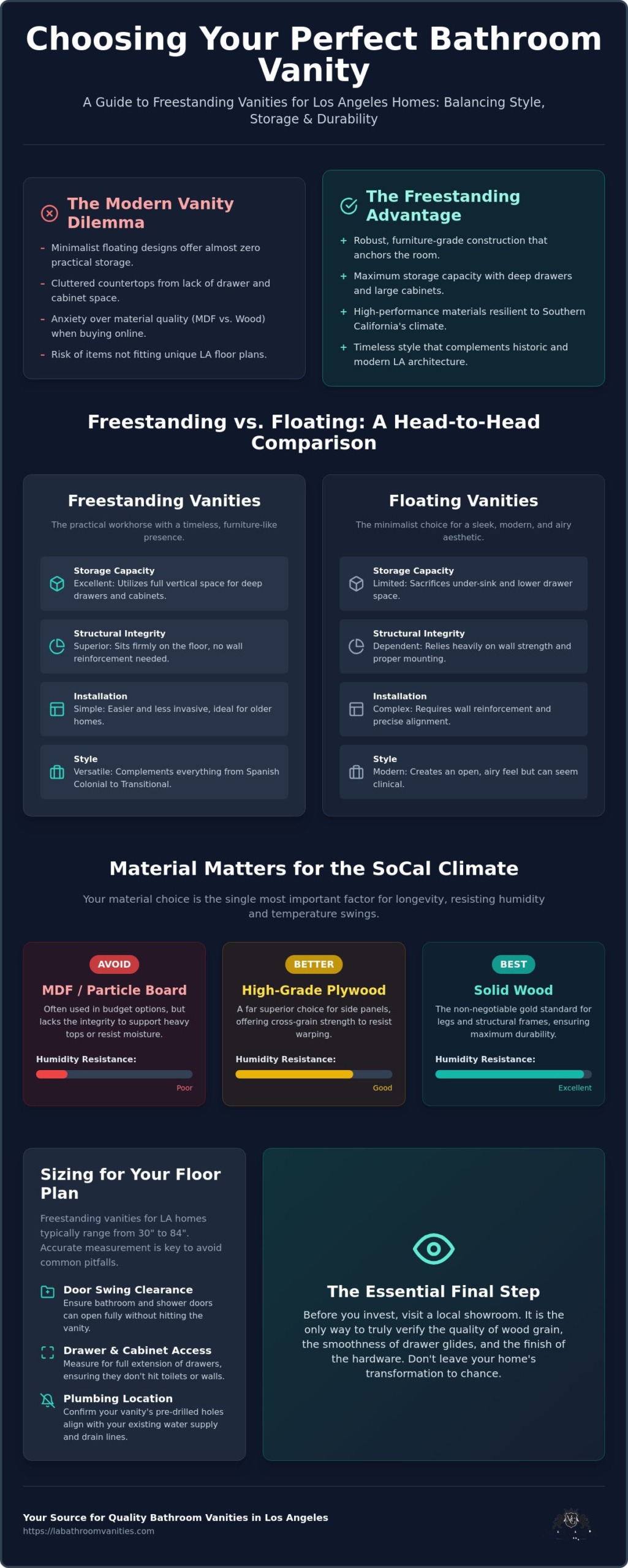
The Ultimate Guide to Freestanding Vanities for Los Angeles Homeowners (2026)

Freestanding vs. Floating Vanities: Which Suits Your LA Remodel?

Are you feeling torn between the trendy, “hovering” look of a wall-mounted unit and the reliable, sturdy presence of freestanding vanities? It’s a common dilemma for Los Angeles homeowners who want a modern aesthetic but don’t want to sacrifice every inch of their precious storage space. While floating models are often praised for their minimalist vibe, they come with hidden complexities that many big-box retailers fail to mention. By choosing a floor-mounted design, you’re opting for a “workhorse of luxury” that provides a grounded feel without the structural headaches of wall-hung alternatives.

One of the most persistent myths in bathroom design is that floating vanities are significantly easier to clean. However, modern freestanding designs with elegant legs offer the same floor access, allowing you to sweep or mop underneath with ease. This “leggy” look provides the same visual break that makes a small Sherman Oaks bathroom feel larger, but it does so without requiring the heavy-duty professional blocking inside the wall that floating units demand. If your wall isn’t structurally reinforced to hold a cantilevered stone top, a floating unit could lead to costly structural repairs down the line.

Installation and Plumbing Logistics

If you’re remodeling an older home in neighborhoods like Silver Lake or Hancock Park, you’ll likely find that freestanding units are much more plumber-friendly. These units naturally hide existing floor-mounted plumbing, which a floating unit would leave awkwardly exposed. By selecting a floor-mounted model, you can often avoid the massive expense of rerouting pipes through the wall. It’s a practical way to save on labor costs while ensuring your renovation remains structurally sound and visually seamless. It’s about making the smart choice that respects your home’s original bones while giving you the high-end update you deserve.

The Aesthetic Debate: Modern Minimalist vs. Sturdy Elegance

Can you achieve a modern look with a freestanding unit? Absolutely. By pairing clean lines with matte black hardware or a sleek plinth base, you can capture that contemporary spirit while maintaining the “grounded” feel that large master suites in Calabasas or Malibu often require. For those expansive 72 or 84-inch double configurations, the visual weight of a freestanding piece provides a sense of permanence and high-end craftsmanship that floating models often lack. To help you map out your floor plan, we recommend reviewing our Bathroom Vanity Sizes: The Ultimate Los Angeles Home Remodel Guide (2026) to ensure your chosen piece fits your space perfectly. This creative journey is yours to lead, and we’re here to provide the professional reassurance you need to make it a success.

Sizing and Storage: Finding the Perfect Fit for Your Floor Plan

Have you ever fallen in love with a piece of furniture only to realize it blocks the bathroom door from opening fully? In the diverse architectural landscape of Los Angeles, from cozy Echo Park bungalows to sprawling estates in Thousand Oaks, selecting the right dimensions for your freestanding vanities is a critical step in your creative journey. It isn’t just about the length of the wall. You must account for door swings, drawer clearance, and the “breathing room” required for a comfortable morning routine. We see many homeowners overlook the depth of the unit, which can make a narrow bathroom feel cramped if not planned with precision.

For many of our neighbors living in classic LA bungalows, mid-sized 36 to 48-inch units have become the go-to standard. These sizes offer a generous amount of counter space without overwhelming the floor plan. If you choose a model with an 8-drawer configuration, you’re gaining an incredible amount of organized storage that keeps your surfaces clear of clutter. This is the professional reassurance we provide: you don’t have to sacrifice style for utility when you choose a piece designed with a furniture-grade soul. It’s about finding that perfect balance where your daily essentials are hidden but always within reach.

Single Sink Solutions: 30 to 48 Inch Options

If you’re working with a guest bath or a powder room, a 48 inch bathroom vanity is often considered the “sweet spot” for functionality. It provides enough room for a single sink while leaving ample space for decor or daily essentials. In tighter LA apartments, a 30-inch vanity acts as a powerful space-saver that still offers significant under-sink storage compared to a pedestal sink. A 36-inch unit is another fantastic option for maximizing counter space in a secondary bathroom without losing that grounded, high-end feel. These units prove that even smaller footprints can deliver massive aesthetic validation.

Master Suite Grandeur: 60 to 84 Inch Double Vanities

In master suite remodels, we’re seeing a definitive shift toward “his and hers” double vanities that serve as the room’s visual anchor. A 72-inch double vanity provides a massive aesthetic impact, offering each person their own dedicated zone for grooming. In luxury markets like Thousand Oaks, the 84-inch model is becoming the new standard for grand master baths. These larger units allow for sophisticated storage setups, such as dedicated drawers for separate grooming tools, ensuring that shared spaces remain harmonious and organized. The emotional reward of a completed project is much higher when your master suite feels like a high-end resort.

Ready to see how these dimensions look in a real-world setting? We invite you to browse our full collection of freestanding vanities and find the perfect fit for your home’s unique layout today.

Why would you risk the success of your master suite remodel on a tiny thumbnail image and a hope that the “solid wood” description is actually true? When it comes to freestanding vanities, there is simply no substitute for the physical experience of testing the craftsmanship yourself. At Milan Gallery, we’ve spent more than 15 years serving as a reliable local authority for Los Angeles homeowners. We invite you into our Sun Valley showroom, one of the largest in the region, so you can run your hands over the natural wood grain and feel the effortless glide of a soft-close drawer. It’s about building immediate confidence in your investment before it ever reaches your front door.

One of the most significant advantages we offer is our “Wholesale to the Public” pricing model. This allows you to access luxury-grade furniture that would typically be reserved for high-end designers at a price point that respects your project budget. If you’re looking for that specific aesthetic validation that will impress your social circle, seeing these pieces in person is essential. You’ll quickly see why our exclusive designs are a bridge between contemporary trends and the time-tested values of quality that our brand represents. We don’t just sell fixtures; we partner with you to ensure your domestic success.

Expert Guidance for Your LA Remodel

Are you feeling confused about the 2025 California Building Standards Code (Title 24) and how it impacts your 2026 renovation? Our expert team is here to provide the professional reassurance you need to navigate these local regulations and plumbing requirements. Whether you’re dealing with the tight size restrictions of a Santa Monica apartment or the expansive layouts of a Glendale estate, we help you choose the right style for your home’s specific era. This guided consultation transforms a potentially overwhelming shopping trip into an inspiring creative journey where your agency as a homeowner is always prioritized.

A One-Stop Shop for Luxury Bathrooms

Creating a cohesive look requires more than just a beautiful vanity; it’s about the social harmony of the entire space. In our showroom, you can see how our freestanding vanities pair seamlessly with LED mirrors or the latest smart toilets. You can even coordinate your choice with our selection of freestanding bathtubs to create a true spa-like retreat. As one of the premier bathroom supply stores in Southern California, we provide the convenience of seeing full sets together. This ensures that every element, from the wood finish to the faucet, works in perfect aesthetic alignment. Visit us in Sun Valley today to touch, feel, and find the dream vanity that will serve as the heart of your home for years to come.

Your Journey to a Perfect Bathroom Starts Here

Choosing the right fixture is about more than just picking a style. It’s about making a reliable investment in your home’s future success. You’ve discovered how freestanding vanities provide the superior storage and structural stability that modern Los Angeles living demands. From selecting moisture-resistant materials to finding the perfect 30 to 84 inch fit for your specific floor plan, every detail matters in creating a space that impresses your social circle while serving your daily needs.

With over 15 years of excellence in the local market, we’re dedicated to helping you find a piece that balances aspirational luxury with grounded practicality. We invite you to step inside the largest showroom in the area to experience our exclusive designs and take advantage of our wholesale pricing on luxury furniture. It’s time to transform your potentially overwhelming remodel into an inspiring creative journey.

Visit Our Los Angeles Showroom to Explore the 2026 Freestanding Vanity Collection!

We can’t wait to help you bring your vision to life and ensure your bathroom becomes the sanctuary you deserve.

Expert Answers for Your Los Angeles Bathroom Remodel

Are freestanding vanities harder to clean than floating ones?

No, modern freestanding vanities with elegant legs are not harder to clean than floating models because they provide enough clearance for a mop or vacuum to pass underneath easily. While floating units leave the entire floor exposed, a leggy design offers a similar airy feel and accessibility. If you choose a plinth-style base that sits flush with the floor, you actually eliminate the need to clean underneath the cabinet altogether, which can be a significant time-saver.

Do I need to anchor a freestanding vanity to the wall?

Yes, you should always anchor your vanity to the wall studs to ensure maximum safety and stability for your household. Even though these units are floor-mounted and incredibly sturdy, anchoring prevents any potential tipping if a child climbs on an open drawer. This simple step also ensures that the unit remains perfectly level and secure against your plumbing connections, providing long-term professional reassurance that your fixture won’t shift over time.

What is the standard height for a freestanding bathroom vanity in 2026?

The standard “comfort height” for a bathroom vanity in 2026 is 36 inches, which matches the height of most kitchen counters. This height has become the preferred choice for Los Angeles homeowners because it reduces the need to lean over while washing your hands or brushing your teeth. While you might still find older “standard” heights of 30 to 32 inches in some specialty cases, the 36-inch benchmark offers the most ergonomic and high-end experience.

Can I install a freestanding vanity myself, or do I need a professional?

You can certainly install a freestanding vanity yourself if you have basic DIY skills, but we generally recommend professional help for the plumbing and drainage connections. In Los Angeles, a permit is required for any remodel that involves altering plumbing or electrical systems according to the 2026 building codes. A professional ensures that your new fixture meets all Title 24 requirements and prevents leaks that could damage your cabinetry over time.

Is solid wood better than plywood for a bathroom vanity in Los Angeles?

Solid wood is the gold standard for the structural frame and legs, but high-grade plywood is actually superior for side panels in our humid Southern California bathrooms. Plywood is engineered to resist the expansion and contraction that occurs with temperature shifts, making it less likely to warp than solid wood panels. We recommend avoiding particle board entirely and looking for freestanding vanities that combine a solid wood frame with premium plywood construction for the best longevity.

How do I choose between a single and double sink for a 60-inch vanity?

Choosing between a single or double sink on a 60-inch unit depends on whether you prioritize shared access or maximum counter space. A single sink provides vast areas on either side for your morning routine essentials, which is a growing trend for many LA master suites. However, if two people need to use the bathroom simultaneously every morning, a double sink configuration is the more practical choice to maintain daily harmony in a busy household.

What are the most popular freestanding vanity colors in LA right now?

Navy blue, matte black, and natural wood finishes like light oak or teak are the most popular choices dominating the Los Angeles market right now. These colors offer a sophisticated aesthetic that complements both modern and transitional home styles. While classic white remains a timeless staple for resale value, many homeowners are choosing deeper tones or natural textures to add a sense of organic luxury and personal character to their private sanctuaries.

Does Milan Gallery offer delivery for vanities in the Los Angeles area?

Yes, we provide reliable delivery options for our customers throughout the greater Los Angeles area, from Santa Monica to the San Fernando Valley. Since these high-end freestanding vanities can be quite heavy due to their solid wood construction and stone tops, our delivery service ensures your investment arrives safely at your home. You can coordinate the specifics of your delivery when you visit our Sun Valley showroom to finalize your selection with our expert team.
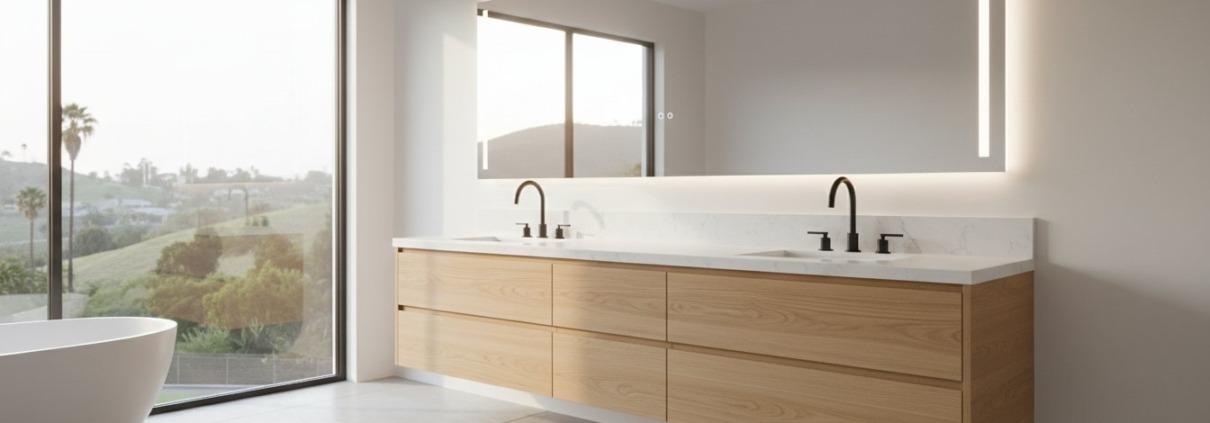
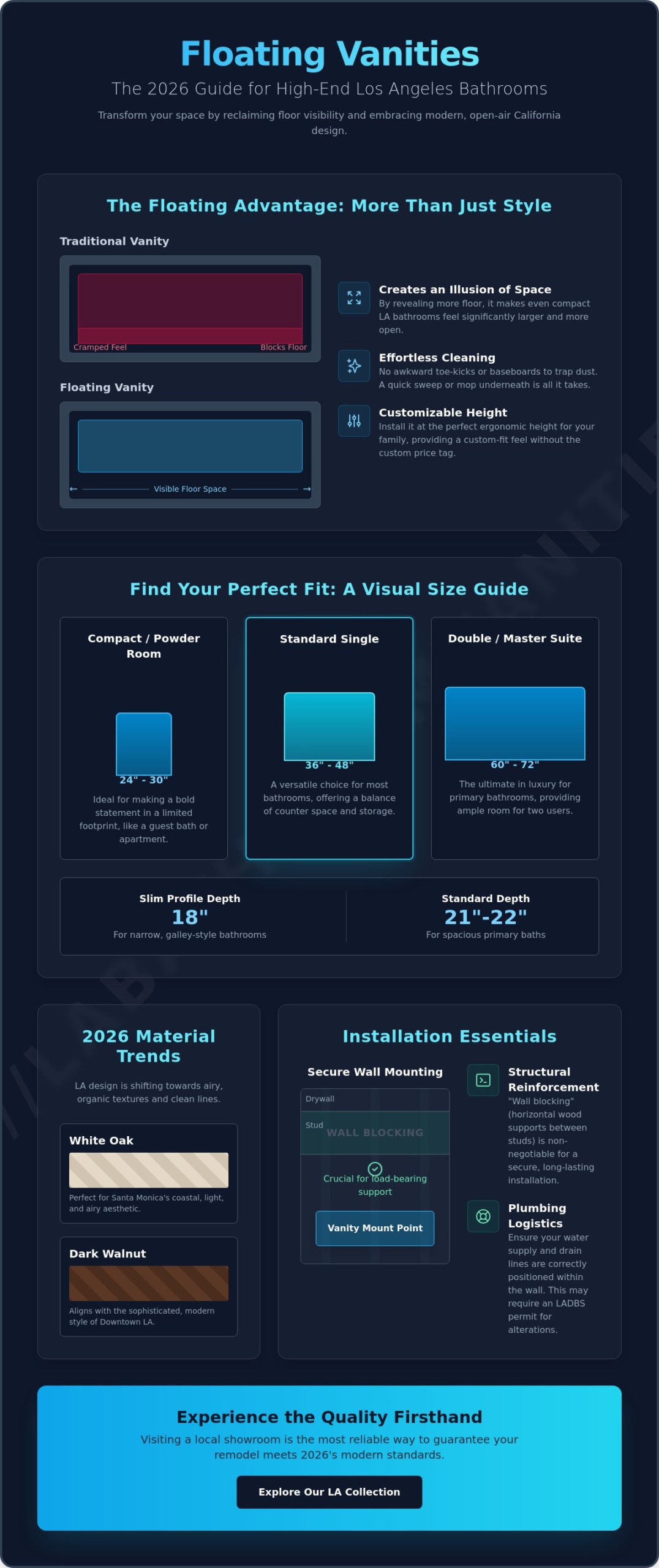
Floating Vanity Los Angeles: The 2026 Guide to Modern Wall-Mounted Design

Floating Vanity Los Angeles: The 2026 Guide to Modern Wall-Mounted Design

Could your bathroom floor be the secret to a high-end remodel that feels twice as large as it actually is? If you’ve ever felt limited by a compact Los Angeles bathroom footprint, you know the frustration of trying to fit luxury into a tight space without it feeling cluttered or cramped. Finding a high-quality floating vanity Los Angeles homeowners can rely on is about more than just aesthetics; it’s about reclaiming floor visibility to create that sought-after, open-air feeling that defines modern California design. We understand the anxiety that comes with wall-mounted fixtures, from worrying about structural weight support to navigating the 2026 LADBS permit requirements for plumbing alterations.

This guide promises to show you how to choose a model that balances 2026’s warmest trends, like white oak and walnut finishes, with the material resilience needed for long-term durability and performance. You’ll learn how to transform your renovation into an inspiring creative journey that results in a truly “Instagrammable” space that provides the aesthetic validation you deserve. We’ll preview everything from selecting the perfect size, whether it’s a 30-inch single or a 72-inch double sink vanity, to pairing your choice with LED mirrors and smart toilets for a complete spa-like retreat that serves as a reliable investment for your home’s future.

Key Takeaways

  • Learn how wall-mounted designs maximize floor visibility to make even the smallest Los Angeles bathrooms feel like expansive, high-end retreats.
  • Discover how to select the ideal floating vanity Los Angeles homeowners prefer for their specific layouts, whether you need a compact 30-inch single sink or a grand 72-inch double sink unit.
  • Identify the specific materials and finishes, such as light oaks or darker wood grains, that align with local neighborhood aesthetics from Santa Monica to Downtown LA.
  • Understand the critical structural requirements, including wall blocking and plumbing logistics, to ensure your new fixture is as secure as it is beautiful.
  • Find out why visiting a local Sun Valley showroom to experience materials firsthand is the most reliable way to guarantee your remodel meets 2026’s modern standards.

Why Floating Vanities are the Top Choice for Los Angeles Remodels in 2026

Have you ever noticed how the most stunning homes in the Hollywood Hills seem to breathe with a sense of effortless openness? That feeling isn’t accidental; it’s a deliberate design choice that prioritizes floor visibility and minimalist silhouettes. In 2026, the floating vanity Los Angeles homeowners are choosing has become the definitive hallmark of modern luxury. By detaching the cabinetry from the floor, these wall-mounted units create a visual lightness that traditional, heavy furniture simply cannot replicate. It’s a strategic move that transforms the bathroom from a purely functional utility room into a high-end sanctuary that feels both expensive and deeply personal.

When you see more of your floor tiles extending all the way to the wall, your brain perceives the entire room as significantly larger. This optical illusion is a game-changer for those navigating the architectural constraints of older Southern California builds. Beyond the aspirational aesthetics, there’s a grounded practicality to this choice that busy professionals appreciate. Cleaning becomes a breeze when there are no awkward corners or dust-collecting toe-kicks to navigate. Additionally, because these units don’t rely on floor contact, you gain the creative agency to set the installation height exactly where it’s most ergonomic for your household, ensuring a custom-fit feel without the need for custom-built cabinetry prices.

The Aesthetic Shift in Southern California Design

Southern California is currently moving away from the bulky, dark cabinetry of the past toward airy, organic textures and clean lines. If you’re looking to bridge the gap between contemporary minimalism and classic quality, a wall-mounted unit is your most powerful ally. These designs perfectly complement the open-concept floor plans that define the modern LA lifestyle, providing that essential social validation when guests step into your home. The evolution of these fixtures is fascinating, especially when you consider the history of the modern sink and how we’ve moved from simple basins to integrated furniture pieces that define a room’s entire character. It’s about creating a space that looks as good on a social feed as it feels during your morning routine.

Solving the ‘Small Bathroom’ Crisis in LA Apartments

In neighborhoods like Santa Monica or Sherman Oaks, where every square inch is a premium, a wall-mounted vanity is a necessity rather than a luxury. It allows you to maximize vertical space without the visual weight that makes a room feel cluttered or claustrophobic. By choosing a high-quality floating vanity Los Angeles experts recommend, you can make a bold statement even in a limited footprint. A sleek 30-inch wall-mounted unit transforms a standard, dated powder room into a sophisticated, high-end gallery that feels intentionally curated and impressively spacious.

Selecting the Right Size: From 24-Inch Powder Rooms to 72-Inch Master Suites

Have you ever stepped into a bathroom where the vanity felt like a giant taking up all the air in the room? In a city where real estate is as diverse as the topography, getting the scale right is the difference between a high-end masterpiece and a cramped mistake. When searching for the perfect floating vanity Los Angeles homes require, you must consider both the width and the profile depth. A standard depth of 21 to 22 inches works beautifully in spacious primary baths in Encino, but narrow galley-style bathrooms often demand a slim-profile unit of 18 inches to maintain a clear walking path. If you’re ready to see how these dimensions look in person, exploring our curated collection of wall-mount fixtures can help you visualize the perfect fit for your specific layout.

Proportionality is the secret sauce of the “floating” effect. If a vanity is too large for the wall, it loses that ethereal, suspended quality and starts to look like a heavy box stuck to the drywall. You also need to account for practical logistics like door swings and shower glass clearance. There’s nothing more frustrating than installing a stunning new fixture only to realize the bathroom door hits the corner of the countertop or the drawers can’t fully open past the toilet. Before you commit, take a moment to map out your floor plan with painter’s tape to visualize the traffic flow and ensure you aren’t overwhelming your space’s visual weight.

Small Space Solutions: 24 to 36 Inches

For guest baths and the increasingly popular Accessory Dwelling Units (ADUs) popping up across Burbank and Glendale, a 30-inch or 36-inch single sink vanity is often the sweet spot. These configurations provide enough counter space for essentials while keeping the floor area open and easy to clean. Even in compact models, you can maximize utility by choosing units with deep, soft-close drawers that utilize the space around the plumbing. See our Bathroom Vanity Sizes guide for more measurement tips to help you navigate these tighter footprints with confidence.

Master Suite Grandeur: 48 to 72+ Inches

When you’re remodeling a primary suite in Santa Monica, the luxury of a 60-inch or 72-inch double sink floating vanity is hard to beat. These larger units create a dramatic focal point that screams high-end luxury. However, it’s vital to balance this visual grandeur with structural security, as wider units carry significantly more weight once you add stone countertops and dual sinks. To complete the look, style these expansive vanities with twin LED mirrors and sleek bathroom faucets to create a symmetrical, spa-like environment that provides the aesthetic validation you’re looking for in a major home investment.

Floating Vanity Los Angeles: The 2026 Guide to Modern Wall-Mounted Design

Matching Your Vanity to Los Angeles Neighborhood Styles

Does your bathroom reflect the unique spirit of your neighborhood? In a city as architecturally diverse as ours, choosing a floating vanity Los Angeles designers recommend means more than just picking a cabinet; it’s about matching the specific architectural DNA of your local community. If you’re living in a sun-drenched Malibu beach house, you’ll likely gravitate toward coastal minimalism. This style relies on light oaks and matte white finishes that capture the natural light, making the room feel breezy and expansive. In contrast, those renovating a high-ceilinged loft in Downtown LA often prefer industrial chic, where darker wood grains and concrete-look tops provide a sophisticated, edgy aesthetic that feels right at home among exposed brick and steel beams.

The beauty of the current market is that there’s a perfect floating vanity Los Angeles style for every home, from the hills to the valley. In Sherman Oaks, the modern farmhouse trend remains a favorite, where we see homeowners balancing the sleek, suspended silhouette of a wall-mount unit with the warm, rustic textures of reclaimed wood. Meanwhile, the mid-century modern influence in Silver Lake continues to drive demand for walnut finishes and tapered, clean lines. By aligning your fixture with your home’s unique history, you aren’t just remodeling a room; you’re creating a cohesive design narrative that feels intentional and high-end.

Material Resilience for the SoCal Climate

While we enjoy a famously dry climate, your bathroom is a micro-environment where moisture resistance is absolutely critical. Even if you don’t have a steam shower, the daily humidity from a hot bath can take a toll on inferior materials. When you’re investing in a wall-mounted unit, the core material is what determines long-term stability. While solid wood is beautiful, high-quality plywood is often the preferred choice for floating units because it offers superior screw-holding strength and resistance to warping. We’re seeing a massive shift in 2026 toward textured wood veneers and high-gloss lacquers that provide a resilient barrier against steam while maintaining that aspirational, furniture-grade appearance.

The Social Payoff of High-End Design

There’s a specific emotional reward that comes with home ownership, and it often centers on the reaction of your guests. Transforming a standard bathroom into a spa-like retreat provides the kind of aesthetic validation that impresses your social circle and significantly boosts your home’s resale value. This is why the collaborative journey with a local expert is so vital; you need a partner who understands that you’re looking for more than a functional box. Milan Gallery Bathroom Vanities’ exclusive designs stand out in the competitive LA market because they bridge the gap between contemporary aesthetics and classic quality. When you choose a fixture that feels like a bespoke piece of art, you’re making a statement about your personal style and your commitment to a beautiful, well-lived life.

Installation Secrets: Ensuring Your Wall-Mount Vanity is Secure

Have you ever looked at a stunning, suspended cabinetry piece and wondered if it could actually withstand the weight of a heavy stone countertop and daily use? It’s a common anxiety for those transitioning from traditional floor-mount designs to the modern elegance of a wall-mounted fixture. Investing in a floating vanity Los Angeles homeowners can depend on requires a proactive approach to structural support that goes far beyond simply finding the studs. Because these units don’t have legs to distribute weight to the floor, the entire load is transferred to your wall’s internal framing, making the “blocking” rule your most important installation secret. You must ensure that horizontal 2×6 or 2×8 lumber is securely installed between the vertical studs before the drywall is finished, providing a continuous and solid anchor point for the cabinetry.

Plumbing logistics also take center stage when you’re aiming for that high-end, airy look. To achieve a truly “Instagrammable” result, you’ll likely need to relocate the P-trap and water lines so they remain hidden within the vanity frame rather than exposed beneath it. Under the 2026 Los Angeles Department of Building and Safety (LADBS) standards, any significant alteration to your plumbing or electrical layout will require a permit, so it’s vital to plan these moves early in your remodel. While high-quality units are engineered for impressive weight capacity, the long-term performance of your investment depends entirely on the resilience of the wall behind it. If you’re ready to see how these engineering marvels look in a real-world setting, explore our high-end wall-mount collection to find the perfect match for your home’s structural needs.

Preparing Your Bathroom Wall

In historic Los Angeles homes, you might encounter plaster and lathe rather than modern drywall, which requires extra care to prevent cracking during the reinforcement process. Identifying your stud locations and ensuring structural integrity is a non-negotiable first step before you even finalize your purchase. For a 60-inch double vanity, the blocking process involves installing horizontal 2×6 or 2×8 lumber between the vertical studs at the exact mounting height to provide a continuous, solid anchor point for the heavy cabinetry and stone top.

Hidden Plumbing and Electrical

Achieving a clean, minimalist silhouette often means moving water lines upward so they enter the vanity through the back panel. This is also the ideal time to add dedicated electrical receptacles for your LED mirrors or smart toilets, especially given California’s 2026 “electric ready” mandates for major remodels. If you need help sourcing the right components for these technical upgrades, explore our Bathroom Supply Stores guide for local trade recommendations that understand the unique demands of the LA market.

Why settle for a digital rendering when you can experience the tactile luxury of a premium finish in person? Finding the right floating vanity Los Angeles homeowners will love for years starts with a visit to our Sun Valley showroom. Here, you aren’t just browsing an aisle; you’re stepping into a creative partnership that bridges the gap between contemporary aesthetics and classic quality. With over 15 years of local expertise, we’ve helped thousands of residents navigate the complexities of Southern California remodels. Our inventory is curated to beat the big-box retailers in both style and material resilience, ensuring your investment doesn’t just look good on day one but performs beautifully for a lifetime.

Big-box stores often prioritize mass production, resulting in vanities made from inferior materials that can’t handle the structural demands of a wall-mount installation. We take a different approach. Every piece in our collection is selected for its ability to provide the aesthetic validation you’re looking for while maintaining the practical security of a reliable investment. We’ve seen it all. Whether you’re dealing with the historic plaster walls of a Silver Lake bungalow or the modern framing of a new build in Valencia, our team provides the professional reassurance you need to proceed with confidence. We understand that your home is your sanctuary, and we’re here to ensure your floating vanity Los Angeles project exceeds every expectation.

Personalized Consultation in Sun Valley

Collaborating with our design experts allows you to find the perfect match for your specific neighborhood vibe. We proudly serve Valencia, Santa Monica, Burbank, and the surrounding areas with premium fixtures that reflect the best of 2026’s design trends. During your visit, we prioritize discussions on material resilience and long-term performance. We’ll help you compare the strength of plywood cores versus standard MDF and explain how our finishes stand up to the unique humidity of a busy Southern California bathroom. It’s a guided personal consultation designed to transform an overwhelming shopping trip into an inspiring creative journey.

Your Next Steps to a Dream Bathroom

To make the most of your showroom visit, we recommend bringing along your current bathroom measurements and a few photos of your space. This allows our team to provide concrete advice on proportionality and traffic flow, ensuring your new fixture fits perfectly. There’s a profound emotional reward in seeing your creative vision come to life. Once you touch the smooth wood grains and test the soft-close drawers of our 60-inch or 72-inch double sink models, you’ll understand why Milan Gallery is the trusted authority for high-end LA renovations. Visit Milan Gallery in Sun Valley today to find your perfect floating vanity!

Step Into Your Modern Sanctuary Today

Are you ready to transform your bathroom from a purely functional room into a high-end retreat that truly impresses? We’ve explored how a floating vanity Los Angeles homeowners select can bridge the gap between contemporary aesthetics and classic quality. By mastering the optical illusion of floor visibility and ensuring your wall has the structural blocking needed for long-term security; you’re investing in a space that offers both daily comfort and significant social validation. Whether you’re refreshing a compact powder room or designing a grand master suite, the right wall-mounted fixture serves as the anchor for your home’s modern evolution.

With over 15 years of experience in the local market, we invite you to experience our exclusive designs firsthand at one of the largest showrooms in the area. Our Sun Valley location features premium fixtures engineered for material resilience, helping you move past the limitations of big-box retailers. It’s time to stop dreaming about that “Instagrammable” bathroom and start creating it with a partner who cares about your success. Browse Our Exclusive Floating Vanity Collection and Visit Our Sun Valley Showroom to find the piece that speaks to your unique style. We can’t wait to help you bring your creative vision to life.

Frequently Asked Questions

Are floating vanities sturdy enough for daily use in a busy household?

High-quality floating vanities are engineered to be incredibly sturdy for daily use, often supporting several hundred pounds when correctly anchored. The key to this durability lies in the material resilience of the cabinetry and the structural integrity of the wall behind it. When you choose a floating vanity Los Angeles experts recommend, you’re getting a fixture designed to withstand the weight of stone countertops and the rigors of a busy family bathroom.

Do I need special plumbing for a wall-mounted vanity in an older LA home?

You will likely need to modify your plumbing to achieve the clean, “floating” look that defines this style. In many older Southern California homes, the drain and supply lines come up through the floor or are positioned too low on the wall. To keep everything tucked neatly inside the vanity frame, a licensed plumber will need to move these lines higher, ensuring the P-trap is hidden from view while complying with 2026 building codes.

How high should a floating vanity be installed from the floor?

The standard installation height for a modern vanity is between 34 and 36 inches from the finished floor to the top of the countertop. One of the greatest benefits of a wall-mounted unit is the creative agency it gives you to adjust this height based on your household’s needs. If you are exceptionally tall or designing a kid-friendly space, you can customize the placement to ensure the most ergonomic and comfortable daily experience.

Are floating vanities more expensive than freestanding models?

Floating models often carry a higher total project cost because they require reinforced wall support and specialized plumbing adjustments. While the price of the fixture itself is comparable to high-end freestanding units, the labor involved in preparing the wall and relocating lines adds a premium to the installation. It’s best to view this as a reliable investment in your home’s modern aesthetic and long-term resale value.

Can I install a floating vanity myself, or do I need a professional?

We strongly recommend professional installation to ensure your vanity is safe and secure. Given the weight of these units and the 2026 LADBS permit requirements for plumbing changes, an expert touch is vital for structural integrity. A professional will know exactly how to handle the reinforcement process and ensure your floating vanity Los Angeles project meets all local safety standards and architectural requirements.

What happens if my bathroom wall doesn’t have the right support for a floating vanity?

If your wall lacks the necessary support, you must open the drywall to add horizontal wood blocking between the studs. This process provides a solid foundation for the mounting brackets to bite into, preventing the unit from sagging or pulling away over time. Without this critical step, even the most expensive vanity risks structural failure, so it’s a non-negotiable part of the preparation phase for any wall-mounted remodel.

Which countertop materials are best for floating vanities in Los Angeles?

Quartz and porcelain are the leading choices for 2026 because they offer a perfect blend of aspirational luxury and grounded practicality. These non-porous materials are highly resistant to staining and moisture, making them ideal for the micro-environment of a busy bathroom. They provide the aesthetic validation of natural stone without the high-maintenance sealing requirements, ensuring your vanity remains a beautiful centerpiece of your home for years to come.

Does a floating vanity really make a small bathroom look bigger?

A wall-mounted unit significantly increases the sense of space by exposing more of the floor tiles. When your eye can follow the flooring all the way to the wall, the brain perceives the room as being larger and more open. This optical trick is a strategic design tool for compact Los Angeles footprints, effectively eliminating the visual weight and clutter that heavy, floor-based cabinetry often creates in tight spaces.

© Copyright 2021, Milan Gallery Bathroom Vanities.
;